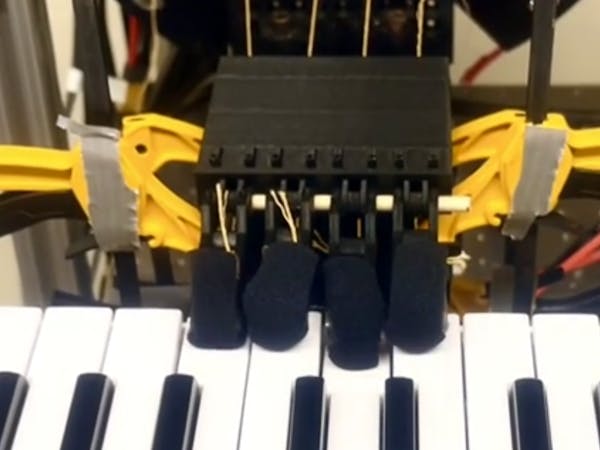
TECH – A team of researchers has unveiled an advanced robotic hand capable of playing piano melodies with remarkable speed, dexterity, and precision, marking a significant step forward in robotic manipulation technology. According to a report by Interesting Engineering, the innovative system was designed to replicate the complex movements of the human hand, allowing it to perform intricate musical pieces that require highly coordinated finger control.
The robotic hand was developed as part of ongoing efforts to improve the way machines interact with delicate objects and perform tasks that demand fine motor skills. While robots have become increasingly capable in industrial environments, reproducing the flexibility and responsiveness of the human hand remains one of engineering’s most difficult challenges. Playing the piano serves as a particularly demanding test because it requires precise timing, controlled force, rapid finger movements, and smooth coordination across multiple joints simultaneously.
Researchers explained that the new system combines advanced mechanical design with sophisticated control algorithms. Each finger can move independently, enabling the robotic hand to strike piano keys with accuracy while maintaining fluid transitions between notes. The technology also allows the hand to adapt its movements in real time, helping it perform complex sequences more naturally than many previous robotic designs.
According to Interesting Engineering, the project demonstrates how robotics is increasingly moving beyond simple repetitive tasks toward activities that require skill, adaptability, and nuanced control. The researchers emphasized that the lessons learned from the piano-playing hand could eventually be applied to fields such as healthcare, manufacturing, and assistive technologies. A robot capable of manipulating piano keys with precision may also be able to handle fragile medical instruments, assemble intricate components, or assist individuals with mobility challenges.
One member of the research team noted that musical performance provides an excellent benchmark for evaluating robotic dexterity because even small errors can become immediately noticeable. The researchers explained that their goal was not merely to create a robot that could press keys, but to develop a platform capable of demonstrating the fine motor control needed for future real-world applications.
Viewed from a broader perspective, the achievement highlights how advances in robotics and artificial intelligence are steadily narrowing the gap between human and machine capabilities. As engineers continue refining robotic hands, tasks once considered uniquely human are increasingly becoming possible for intelligent machines, opening new opportunities across a wide range of industries.