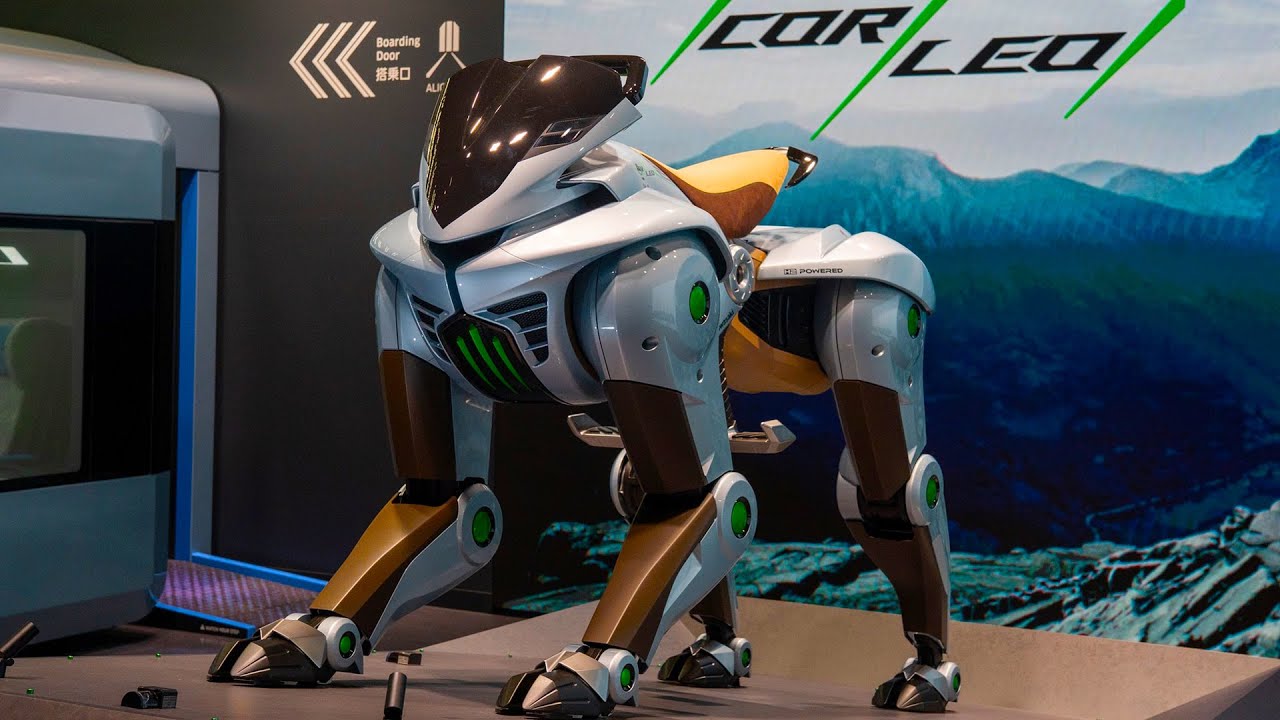
TECH – Japan’s Kawasaki Heavy Industries is moving its eye-catching robot horse concept, long dismissed by some as futuristic vaporware — closer to reality, announcing plans to develop a production-ready version of Corleo, a rideable, four-legged off-road robot powered by hydrogen, with commercial availability targeted around 2035. Originally unveiled in CGI form and showcased as a concept at Expo 2025 Osaka, the Corleo has captured global attention with its blend of robotic agility, clean energy and unconventional mobility.
Designed to combine the mobility of a motorcycle with the stability of a quadruped, Corleo isn’t just another sci-fi fantasy — Kawasaki has now created a dedicated team, called the Safe Adventure Business Development Team, to bring the machine from concept to prototype and eventually to market by mid-decade. The company plans to reveal a functioning prototype by Expo 2030 in Riyadh, Saudi Arabia, using this premier global stage as a testbed for performance and public interest while refining engineering challenges.
What sets Corleo apart from traditional ATVs and off-road vehicles is its biomimetic design and hydrogen-powered drivetrain. The robot uses a 150 cc hydrogen engine to generate electricity that powers independent drive units in each of its four legs — each fitted with rubberized, slip-resistant hooves that help tackle uneven terrain. This allows Corleo to shift, balance and traverse rocky hills, grasslands and rough trails much like an animal would, but with mechanical precision and strength.
Read More: Russia Debuts Ion-Based Quantum Computer Equal to 72 Qubits
Control of Corleo isn’t based on a joystick or dial. Instead, Kawasaki engineers have developed an intuitive human-machine interface that reads a rider’s weight shifts and body posture to guide movement, direction and balance — striving to create a feeling of unity between human and machine reminiscent of horseback riding or motorcycle leaning dynamics. An onboard heads-up display feeds the rider real-time information on hydrogen levels, center-of-gravity position, terrain data and navigation cues to enhance safety and engagement.
In talking about the robot’s long-term vision, Kawasaki emphasises that Corleo isn’t only about thrills or novelty. It’s “a robot that obeys humans, moving as they need,” designed to take riders into environments unreachable by conventional vehicles — places where hiking is difficult and wheeled vehicles struggle. The domestic demand following the 2025 Osaka Expo was one of the key reasons the company moved toward commercialisation, toggling the project from impossible dream to plausible future transport option.
While production remains years away, and full performance specs like speed, range and hydrogen refueling infrastructure are still evolving, Corleo points to a broader trend in robotics and mobility — where clean energy, intuitive interaction and terrain-adaptive design collide to imagine a future far beyond wheels and paved roads. It’s a vision that blends eco-friendly propulsion with dynamic locomotion, ushering in a new era where riders might truly mount a mechanical steed to explore the wild.