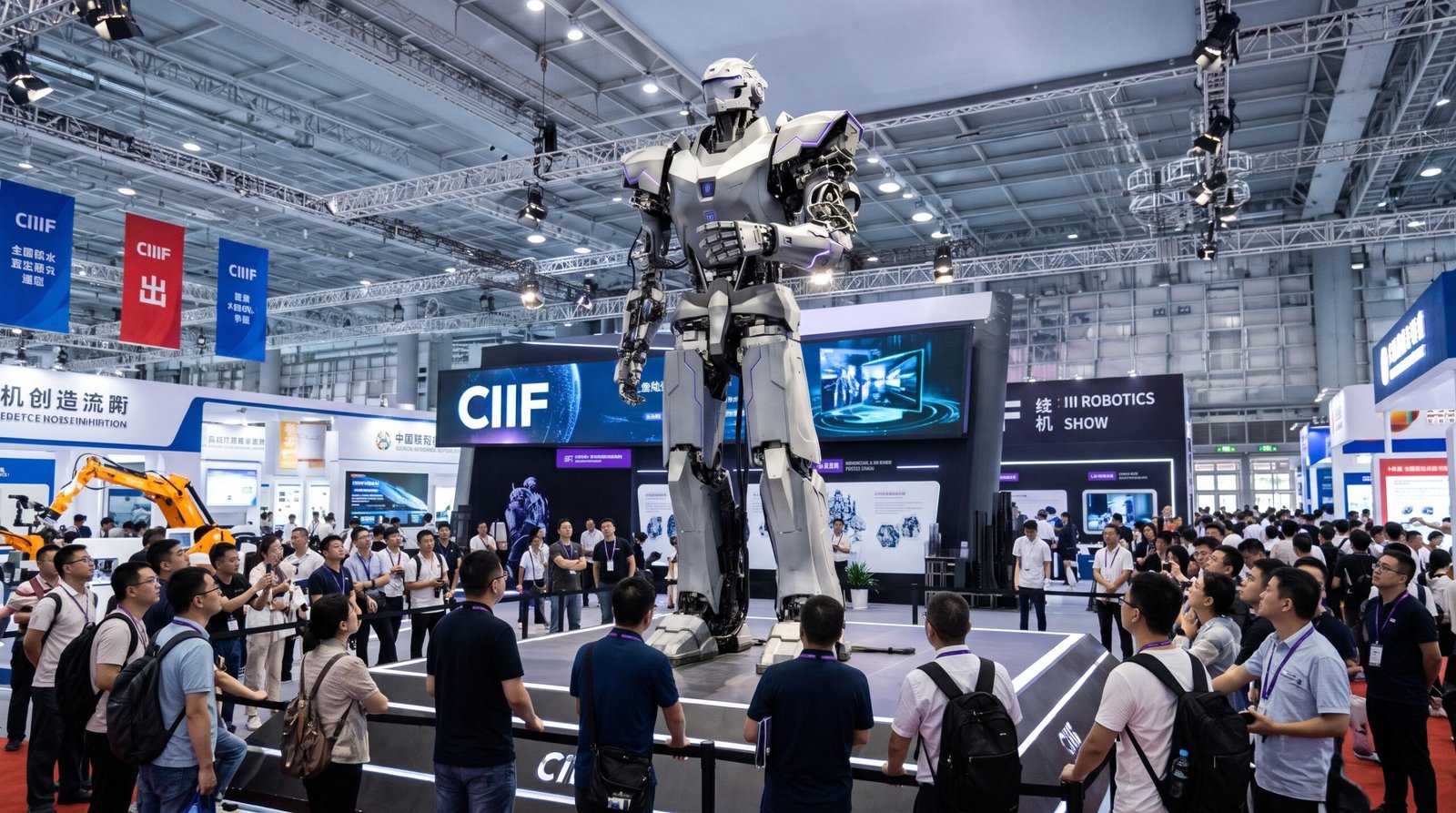
TECH – China has unveiled a towering humanoid robot designed to handle industrial tasks that would challenge even the strongest human workers. Standing approximately 13 feet (four metres) tall and weighing around 1.2 metric tonnes, the machine, called Neo1, is being developed by Beijing-based robotics startup NeodraDynamics. According to Yahoo News Malaysia, which republished reporting from The Independent, the robot is designed to push beyond the physical limitations of conventional humanoid machines.
Neo1 made its appearance at the 2026 China International Industry Fair, attracting attention with its enormous frame and reported lifting capabilities. Its developers claim that the robot can carry a combined load of up to 500 kilograms using both arms, roughly equivalent to the weight of a small car or a fully grown cow. However, these performance figures have yet to be independently verified, and the exhibition model demonstrated only limited limb movements.
Unlike many humanoid robots that rely primarily on conventional electric motors, Neo1 combines hydraulic actuators with electric drives. Hydraulic systems use pressurised fluid to generate substantial force, making them suitable for lifting heavy objects and operating in demanding industrial environments. According to NeodraDynamics, the robot features 41 active joints, most of which are powered by hydraulic mechanisms, while electric drives provide additional control for specific movements.
The company believes this hybrid approach could overcome some of the power and durability limitations affecting existing robotic platforms. Founder Yang Tao explained the technology’s purpose, saying, “Our hydraulic-electric hybrid base technology solves the fundamental power and durability pain points of robots, enabling embodied intelligence to truly take root in industrial scenarios and empower industrial upgrading.”
Read More: YMTC Targets 9,600 MT/s LPDDR5X Memory Mass Production
Rather than competing directly with smaller humanoid robots designed for household assistance or general factory duties, Neo1 targets demanding applications where strength matters more than compact dimensions. Its intended roles include heavy assembly, mining operations, port cargo handling, deep-sea maintenance, and clearing debris in disaster zones. These environments can expose human workers to dangerous machinery, unstable structures, toxic substances, and other serious hazards.
NeodraDynamics has also advertised fingertip precision of 0.01 millimetres, suggesting that the machine could eventually combine heavy lifting with delicate operations. The company has even suggested that its embodied artificial intelligence could one day support household applications, although its immediate focus remains industrial work.
The unveiling comes as China invests heavily in artificial intelligence and robotics to modernise its manufacturing sector. The country already operates millions of industrial robots and accounts for a substantial share of new factory robot installations worldwide. Government support and domestic supply chains have helped Chinese manufacturers accelerate development, intensifying competition in the global robotics industry.
Nevertheless, Neo1 still faces a significant challenge: proving that its impressive specifications translate into reliable real-world performance. Its price, commercial launch date, and deployment timeline have not been confirmed publicly.
For now, the giant robot represents an ambitious experiment in combining mechanical strength with intelligent automation. Whether Neo1 becomes a practical industrial workhorse or remains an eye-catching engineering showcase will depend on how successfully its developers move from demonstrations to dependable operations.