TECH – In the crowded rhythm of modern cities, where footsteps echo and trains arrive like clockwork, China is quietly rewriting the choreography of public transport—not with more people, but with machines that walk, fly, and think. According to reporting by eWeek, the city of Hefei has introduced an experimental “full-space” robotic system inside its metro network, blending robot dogs, drones, and humanoid machines into a single coordinated force.
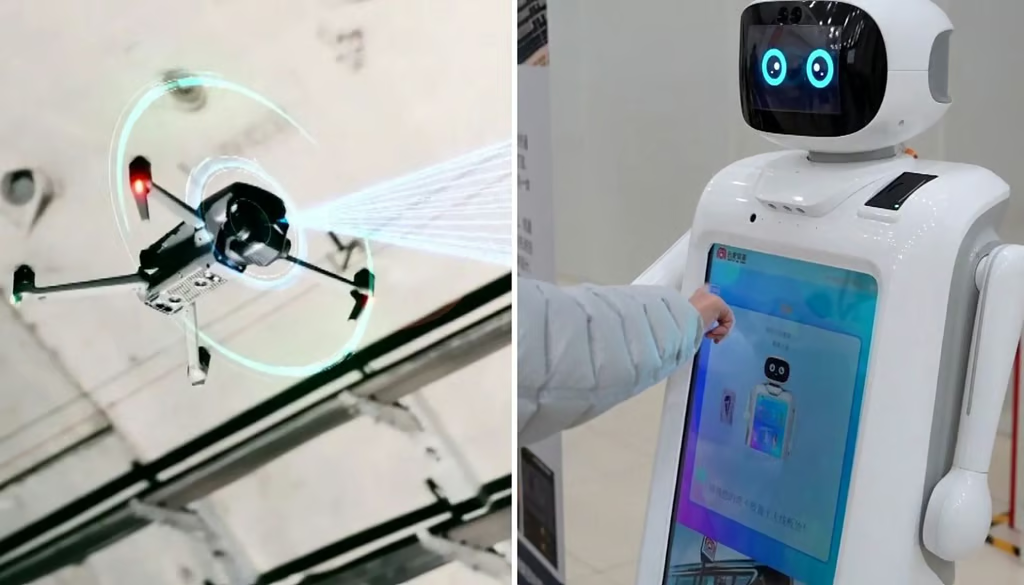
The rollout unfolded during one of the busiest travel periods of the year, the Spring Festival rush, when stations swell with millions of passengers. Amid the usual human tide, something unusual appeared: robotic dogs patrolling platforms, drones gliding through tunnels, and humanoid robots calmly guiding commuters. These machines are not isolated tools but part of a synchronized ecosystem, managed through a centralized platform that ensures every corner of the metro—from open stations to hidden maintenance zones—is continuously monitored.
Dai Rong, director at Hefei Rail Transit’s Science and Education Center, explained the system’s scope with clarity: “The full-space robot intelligent dispatching platform mainly operates in three areas: intelligent service within stations, vehicle inspection, and tunnel inspection.” His words sketch a vision where machines extend human capability rather than replace it.
Read More: Meet “Cy-Trust”, a New Framework Secures Robot and Self-Driving Networks
Each type of robot plays a distinct role. Humanoid units interact with passengers, answering questions and offering directions, while robot dogs handle ground-level patrols, ensuring safety across platforms. Meanwhile, drones take to the air, inspecting tunnels and hard-to-reach infrastructure. Beneath the surface, autonomous machines navigate narrow maintenance trenches, scanning train components with high-definition cameras and ultrasonic sensors to detect faults that human inspectors might miss or take hours to uncover.
The system’s purpose is not merely efficiency—it is also protection. Tasks that are repetitive, physically demanding, or potentially dangerous are now delegated to machines, allowing human staff to focus on decision-making and passenger care. Dai Rong emphasized this balance, saying, “We hope it can assist human staff, improve our work efficiency, and reduce work intensity.”
Looking ahead, researchers aim to equip these robotic teams with even more advanced artificial intelligence, creating a centralized “brain” capable of interpreting complex situations and responding in real time. As Luo Lei, a senior supervisor, noted, the goal is to enable robots to “respond to various abnormal situations more accurately.”
Read More: China Showcases Armed Robot Dogs for Future Warfare
Seen from a wider lens, this innovation feels like a quiet preview of tomorrow’s cities—places where humans and machines move together in shared spaces, each learning the rhythm of the other, until efficiency becomes almost invisible and technology fades into the background of everyday life.