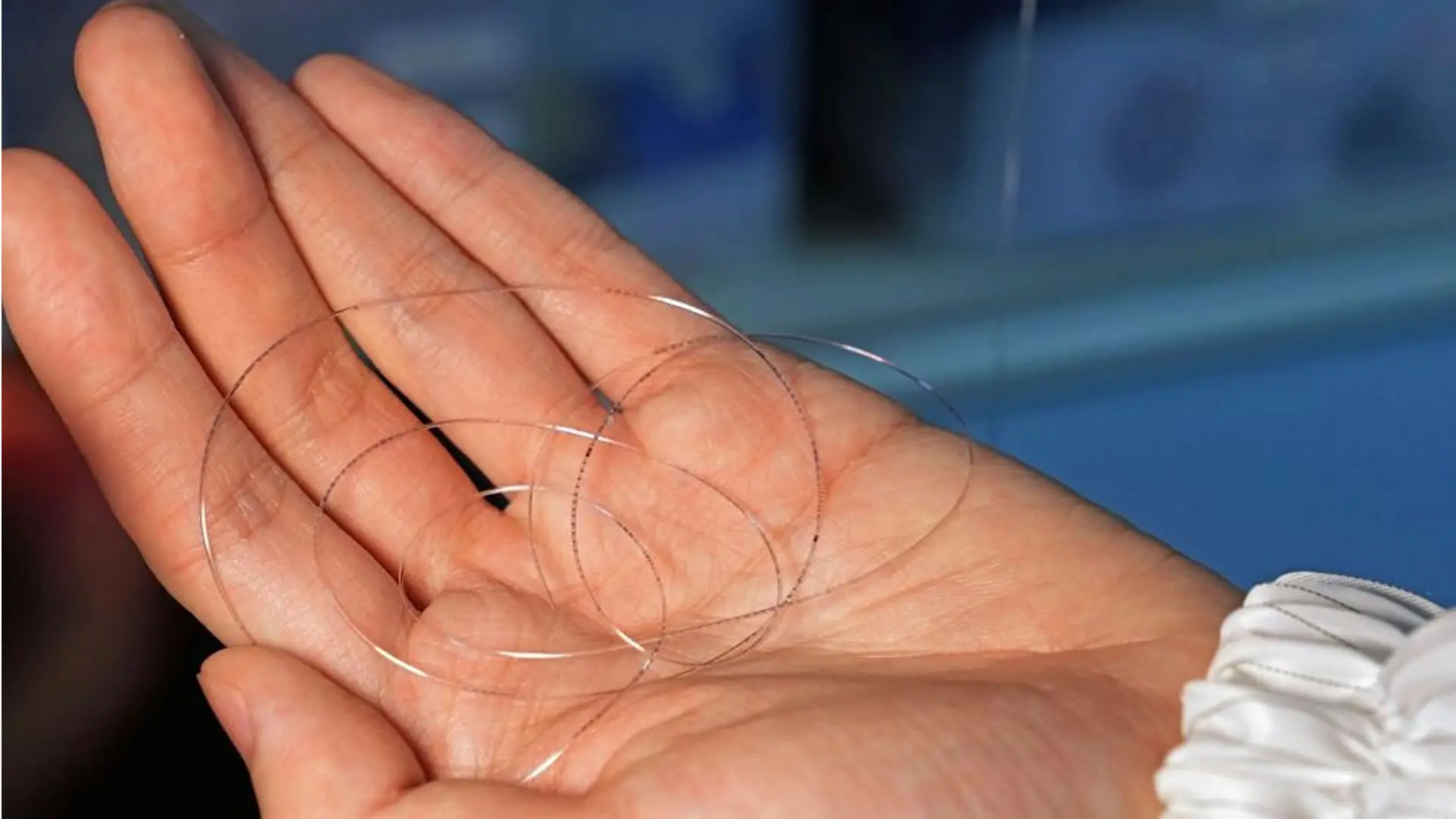
TECH – In a leap toward a future where computing power blends seamlessly with the fabrics and materials of everyday life, Chinese scientists have succeeded in building semiconductor chips inside fibers as thin as human hair, a breakthrough that could redefine electronics, wearables and even medical implants, according to South China Morning Post (SCMP) reporting. Instead of flat silicon wafers, researchers at Fudan University in Shanghai engineered fully integrated circuits on elastic, flexible threads — meaning that clothes, gloves or even soft robotics could one day process information just like a computer does.
The innovation, described in the journal Nature, centers on what the scientists call fiber integrated circuits (FICs) — transistors, resistors, capacitors and other essential electronic components woven into strands roughly the diameter of a human hair. Each fiber reaches transistor densities approaching 100,000 per centimeter, a level comparable to conventional chip integration used in today’s computer processors, despite being wrapped in a stretchable, bendable form. At current laboratory precision, a fiber just one millimeter long can host tens of thousands of transistors, while extending it to one meter could bring the transistor count close to that of a full-scale computer CPU.
The team, led by researchers such as Peng Huisheng, told media that emerging technologies like brain-computer interfaces demand electronics that match the softness and flexibility of biological tissue, not rigid blocks of silicon. Instead of traditional flat chip surfaces, their method involved patterning ultra-precise circuits on elastic polymer sheets and rolling them into cylindrical fibers an approach likened to “rolling sushi” by one researcher. The result is a chip that can stretch, bend and twist far beyond the limits of conventional electronics.
Read More: Innovative Pressure Geothermal Plant Secures Funding for Power
Tests have shown these fiber chips can withstand real-world stresses that would destroy typical electronics, surviving over 10,000 bending cycles, enduring machine washing, tolerating heat up to 100 °C and even surviving compression under a 15.6-tonne truck. This resilience makes them ideal for smart textiles that compute or display information, wearable devices that interact with users, and potentially soft medical implants that match the mechanical properties of human tissue while processing signals.
What sets these fiber chips apart is not just flexibility but integrated functionality: the strands carry power, sensing, data processing and communication functions in a single unit, removing bulky wiring and external components. The development suggests a future where clothing might act like a smartphone screen, sportswear could show live health data, and medical implants could process neural signals directly inside the body — computers not on us, but woven into us.
While still in the experimental phase, the work’s early success in scalable manufacturing hints at a path toward mass production, inviting a shift in how electronics are designed, integrated and experienced in daily life.