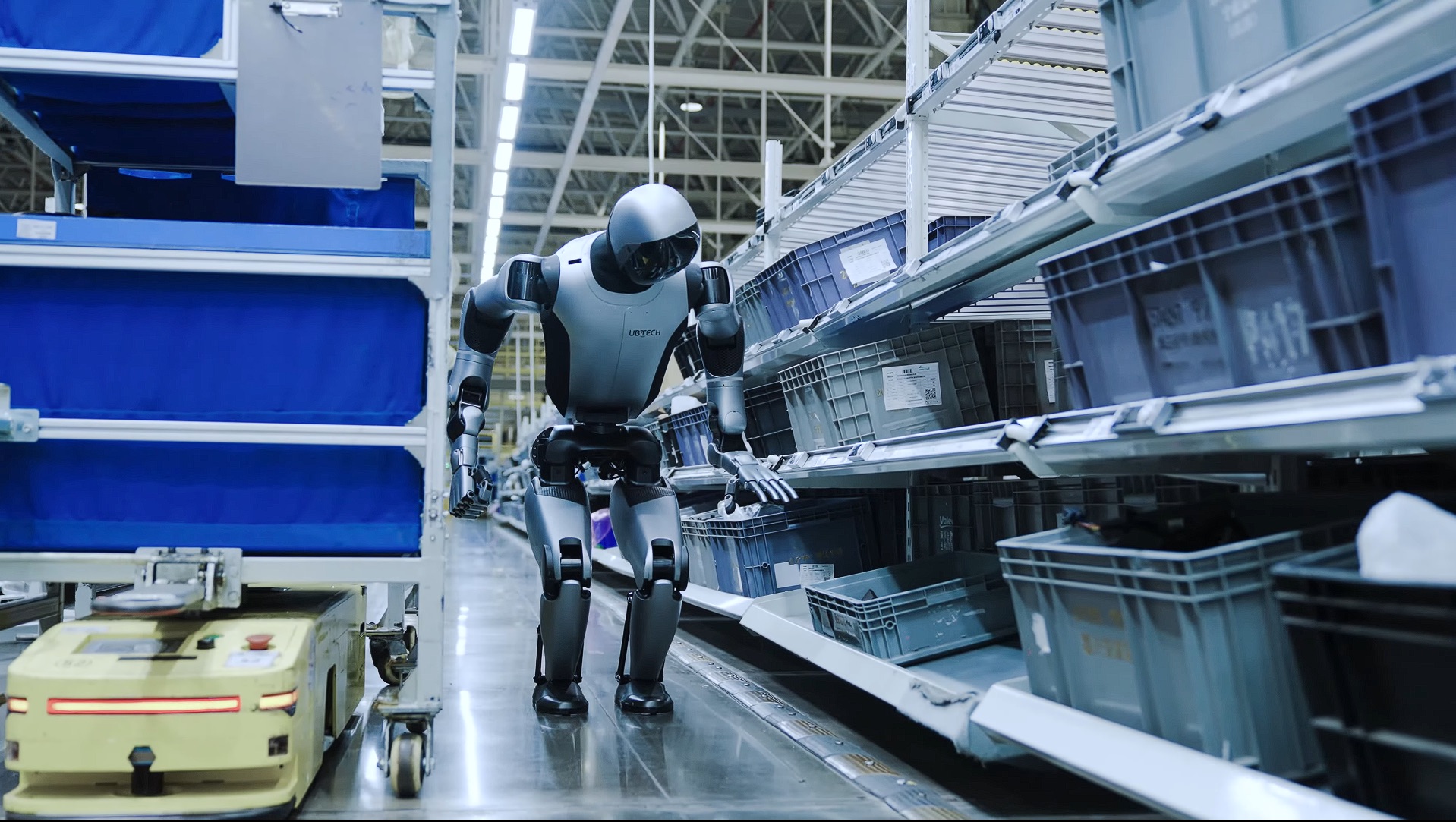
TECH – Airbus, the world’s largest aircraft maker, is exploring a future where humanoid robots could become familiar figures on its factory floors after placing an order for Chinese-built Walker S2 robots to test on its production lines, according to reporting by Vietnam.vn and corroborated by Reuters. In a sign of how far robotics is advancing, the deal with Shenzhen-based UBTech Robotics places next-generation android-style machines into the demanding environment of aerospace manufacturing, a domain that has traditionally relied on highly skilled human hands.
Airbus confirmed it had bought the Walker S2, UBTech’s most advanced humanoid model so far, but emphasized that this phase is a pilot project an initial experiment to see how these robots might be woven into assembly operations rather than a wholesale replacement of workers. The Walker S2 stands about 1.76 meters tall and weighs 43 kg, with dozens of flexible joints that let it move in ways that closely resemble human motion. Its five-fingered hands, which can carry up to 15 kg, are designed to handle intricate components and tools with precision in settings where grip and finesse matter as much as strength.
Read More: Takaichi’s Big Spending Push Sends Japan’s Surplus Plans Astray
Equipped with a suite of sensors like cameras and LiDAR on its head, the robot can map its surroundings, measure depth, and navigate safely around people and obstacles on the shop floor, all guided by UBTech’s Co Agent artificial intelligence system. This AI helps the Walker S2 “think” autonomously by recognizing objects and coordinating complex movements rather than simply following rigid pre-programmed instructions. One of its standout technical features is the ability to manage its own power supply: with two independent battery modules, the robot can automatically detach a nearly empty module and replace it in about three minutes, allowing for continuous work without human help.
Read More: HybridLeg Robot Pushes Real-World Biped Walking with AI
UBTech CEO representatives have described the partnership as a leap forward for integrating humanoid robotics into real-world industrial tasks, saying that working alongside humans in precision-demanding roles like aerospace assembly could redefine modern manufacturing processes.
Beyond aircraft production, the company also recently signed a deal with U.S. semiconductor giant Texas Instruments to provide Walker S2 units for chip plant operations, signaling rising confidence in Chinese humanoid robots within advanced tech sectors. The move by Airbus comes amid a broader global trend toward automation in heavy industry, where flexible, intelligent robots are increasingly seen as complementary partners to human workers, especially in tasks that are hazardous or ergonomically challenging. As Airbus continues its trials, it may pave the way for a future in which robots and people build the planes of tomorrow together — blending human ingenuity with machine precision.