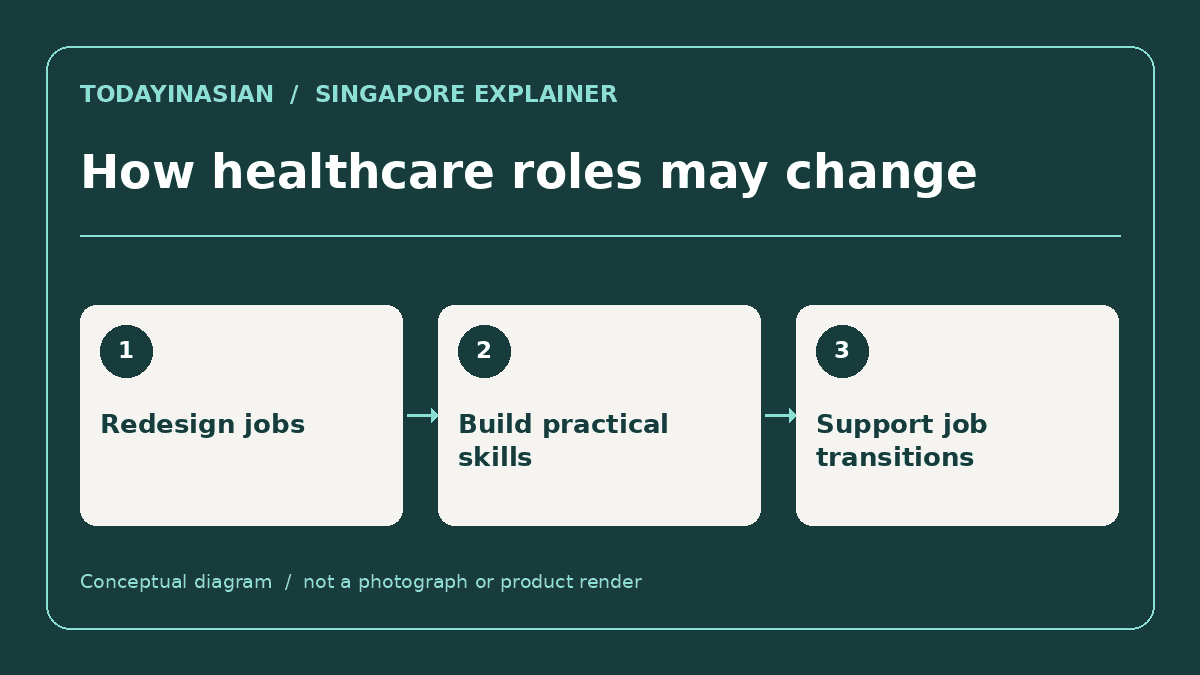
SINGAPORE,- Singapore is setting up a council to redesign healthcare jobs and prepare staff for a system that delivers more care in the community. Health Minister Ong Ye Kung announced the Healthcare Jobs, Skills and Training Council on 27 November. Its first meeting, planned for April 2027, is expected to develop a workplan. The announcement sets a direction for employers and training providers; it does not itself expand any worker’s clinical responsibilities.
The council will bring together government, public healthcare employers and the Healthcare Services Employees’ Union. Minister of State Rahayu Mahzam and union and NTUC president K Thanaletchimi will co-chair it. Ong singled out nurses, pharmacists and allied health professionals as groups to start with when considering how roles might change.
Why a change in care setting changes the job
The shift is not simply about moving an appointment from a hospital to a room nearer a patient’s home. Staff in the community may need to coordinate with several teams, decide what falls within their role and know which concerns require another professional. Ong used community health posts as an example of where a nurse could take on more responsibilities if supported by clear protocols, training and a way to obtain help. Those safeguards distinguish an expanded role from extra duties with no extra support.
CNA’s reporting framed the redesign in the context of an ageing population. For patients and carers, the important question is whether more needs can be addressed near home without making it harder to see a specialist when necessary. A test of the redesigned system should look at continuity of care and referral delays as well as the number of appointments moved.
What workers should watch for
Ong called for modular training tied to work that staff would actually perform. He identified effective use of technologies such as AI as one part of the skills agenda, alongside working across disciplines. That does not mean an AI tool is being prescribed for every role. A useful training module should clarify the limits of a tool, who reviews its output and when a worker must seek help.
A workplan would be most useful if it spells out which roles are being trialled, how staff receive time and support to train, and what career paths will recognise the new responsibilities. It should also explain how workers whose roles change substantially can raise concerns or obtain retraining. Those details will make the difference between a broad ambition to modernise care and changes that staff and patients can actually see.
April’s meeting is therefore a milestone to watch, not a deadline for patients or a start date for new services. One early signal will be whether the council identifies a handful of tasks to test and describes how it will measure safety and workloads. That would give frontline teams something specific to evaluate.