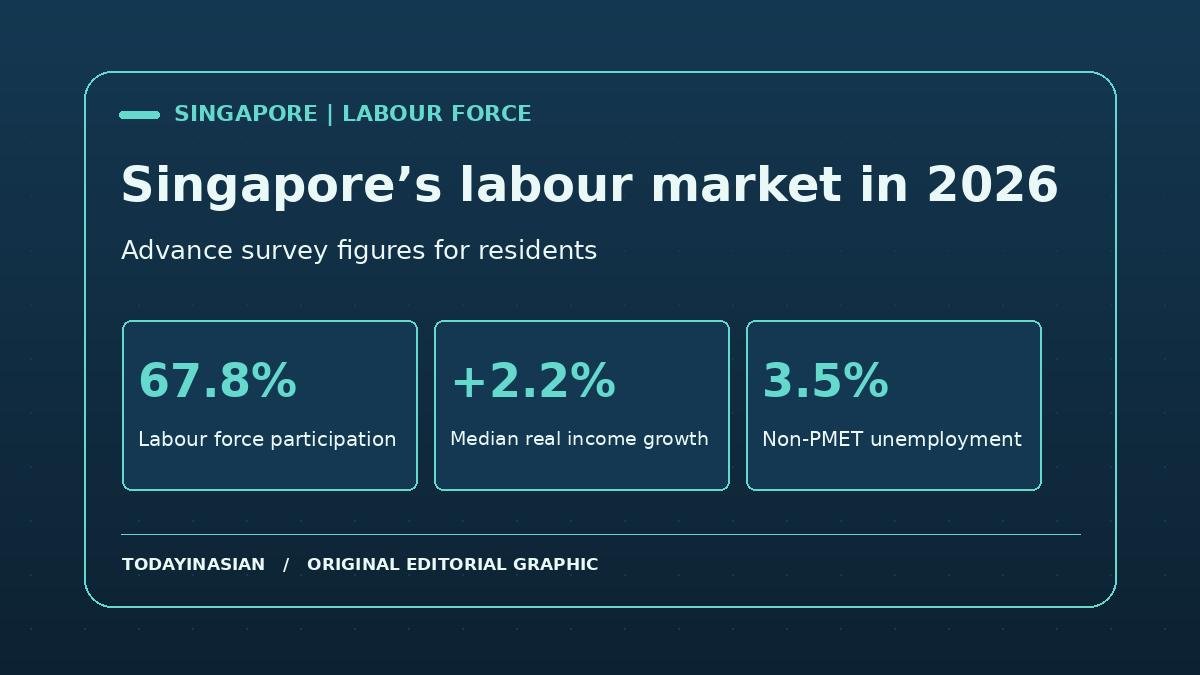
SINGAPORE,- Full-time resident workers in Singapore earned more in inflation-adjusted terms in 2026, but the increase was smaller than a year earlier. And while the overall jobs market remained relatively resilient, workers outside professional, managerial, executive and technical occupations experienced a rise in unemployment. Both shifts matter more for households planning their next move than the small change in the overall participation rate.
The Ministry of Manpower’s advance release on 27 November put median real income growth for full-time employed residents at 2.2 per cent, down from 4.1 per cent in 2025. At the 20th percentile, an indicator of earnings near the lower end of the distribution, growth eased from 3.6 to 1.3 per cent. The underlying measure is gross monthly employment income including employer or platform operator Central Provident Fund contributions, so it is not the same as take-home pay.
Why participation can fall even when individual age groups hold steady
The overall share of residents aged 15 or above participating in the labour force edged from 67.9 to 67.8 per cent. The ministry attributes the longer decline since 2021 mainly to population ageing. Prime working-age and senior residents’ participation was broadly stable or rose in the age groups reported. That is not a contradiction: as older age groups make up more of the population, the overall share can fall even if participation within those groups does not.
This distinction affects what employers should watch. An economy can face a smaller share of available workers because its age profile has changed, even when demand is soft in individual industries. Job redesign and workable schedules for older employees address a different problem from retraining staff whose roles are being changed or eliminated.
A cooler market does not affect every occupation in the same way
Unemployment for professionals, managers, executives and technicians held broadly stable at 2.7 per cent, while the rate for non-PMET residents increased from 2.8 to 3.5 per cent. CNA’s reporting on the release highlighted the same split alongside the slower rise in lower-end real income. Meanwhile, the ministry reported fewer job changes, although around seven in ten of the eligible job switchers it tracked saw real income gains.
The last figure should not be read as a forecast for every person considering a move. It describes workers who switched, not everyone who looked for a different role. Future wage gains will vary with role, sector and bargaining power. When comparing offers, an employee can ask whether the increase still looks meaningful after taking account of hours, commuting costs and benefits.
The Manpower Research and Statistics Department describes the findings as preliminary results from its annual survey and expects a full report at the end of January 2027. Those fuller tables will make it easier to see which groups are driving the headline figures. Until then, slower income growth and uneven unemployment offer a more useful reading of the labour market than assuming the headline changes apply to everyone.
Original editorial graphic by TodayinAsian. Data: Ministry of Manpower’s advance release of 27 November 2026. Each card uses the population defined for that indicator.