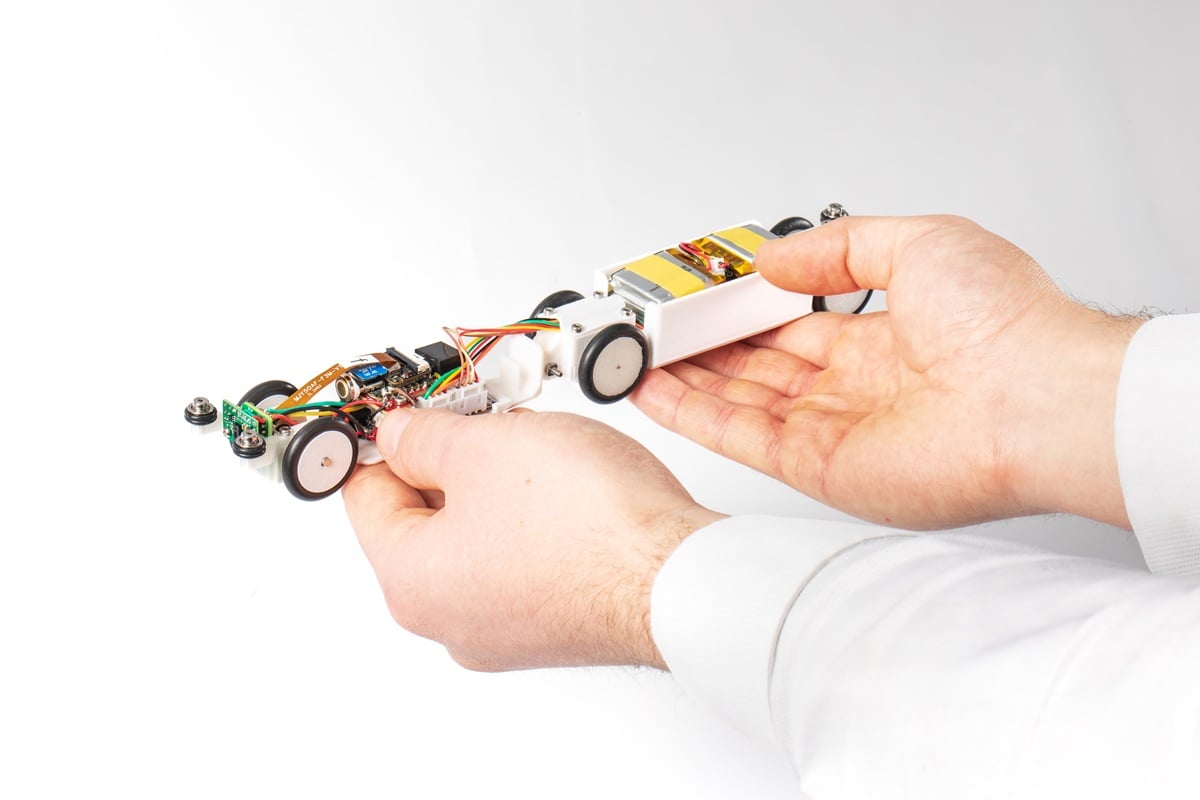
TECH – In the silent tunnels beneath the Franco-Swiss border, where particles race near the speed of light, a tiny mechanical explorer is preparing to take on one of science’s biggest machines. Engineers from the UK Atomic Energy Authority (UKAEA) and CERN have developed a mouse-sized robot designed to travel inside the Large Hadron Collider (LHC) to inspect delicate components that are normally difficult for humans to reach, according to reporting by Interesting Engineering.
The device, named PipeINEER—a blend of the words “pipe” and “pioneer”—is a slender robot built to crawl through the narrow beamline pipes that carry particle beams within the 27-kilometer-long collider. These pipes form the heart of the LHC, the world’s most powerful particle accelerator, where subatomic particles are smashed together so physicists can explore the fundamental structure of the universe.
Maintaining such a colossal scientific instrument is extremely challenging. The beamline environment operates under ultra-high vacuum and extreme cold, with superconducting magnets cooled to around -271°C, conditions that make manual inspection nearly impossible. Engineers usually need to dismantle large sections of equipment to check for damage—an expensive and time-consuming process. The tiny robotic inspector aims to change that.
Read More: Peking University Unveils 1 nm Ultra-Low Power Chip Breakthrough
Measuring roughly 20 centimeters long and capable of navigating spaces only 3.7 centimeters wide, the robot is designed to move autonomously through pipes for kilometers at a time. Powered by onboard batteries, it can travel distances of up to six kilometers on a single mission, capturing images and analyzing them using artificial intelligence trained on real LHC inspection data. If the robot detects anomalies—such as bent radio-frequency contact strips inside plug-in modules—it returns to its starting point and reports the exact location of the problem.
Researchers involved in the project say the innovation could dramatically reduce maintenance time while improving safety for technicians. In explaining the concept highlighted by Interesting Engineering, engineers described the robotic system as a way to monitor the collider without dismantling large sections of infrastructure.
Looking at the broader picture, the tiny machine represents more than clever engineering. It demonstrates how robotics and artificial intelligence are becoming essential tools for maintaining complex scientific facilities. By sending a robot where humans cannot easily go, scientists hope to keep the LHC running efficiently—ensuring the world’s most ambitious physics experiments continue probing the mysteries of matter and the origins of the universe.