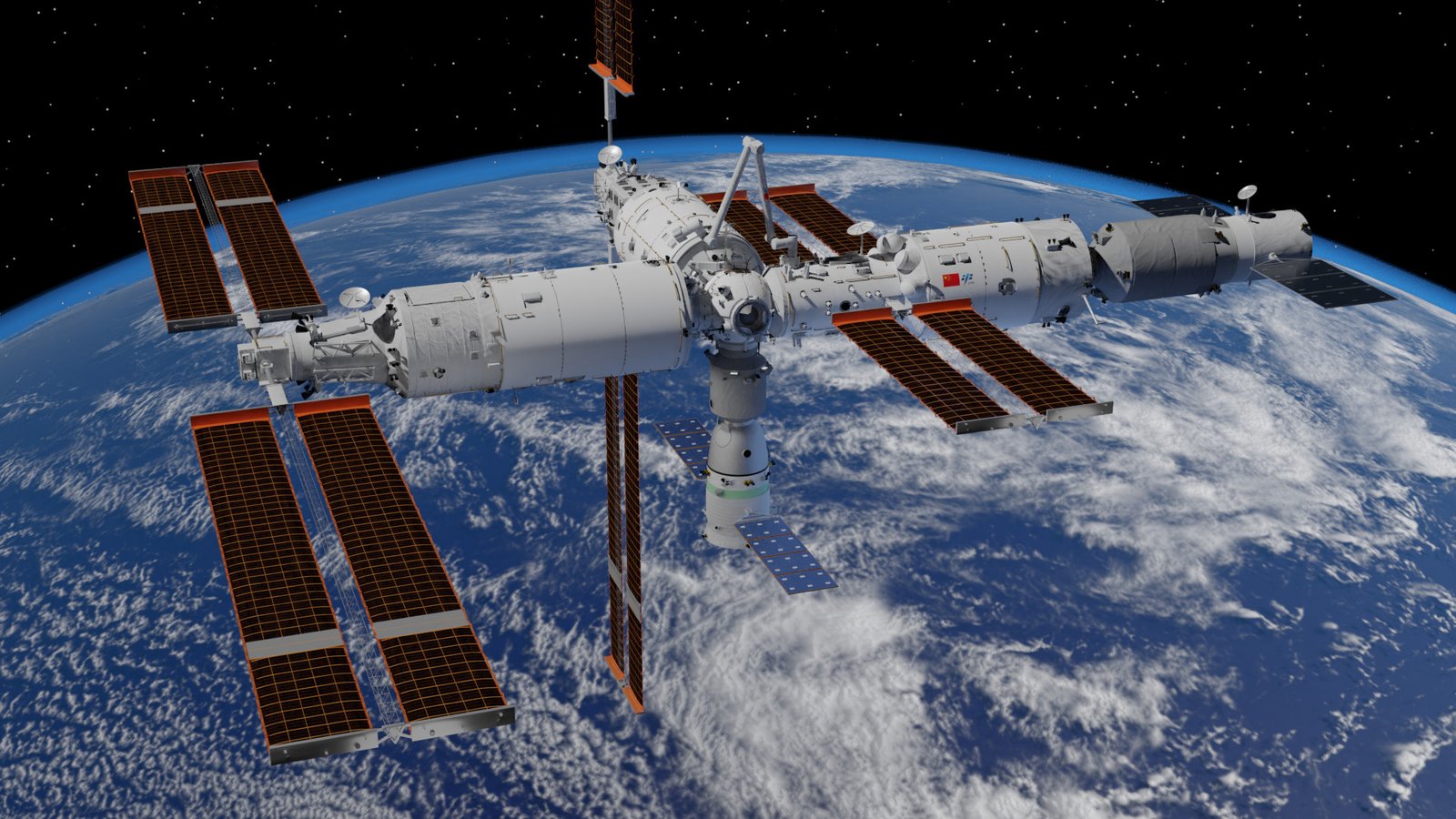
TECH,- China’s Shenzhou-24 spacecraft has reached the Tiangong space station with two Chinese astronauts and Pakistani payload specialist Muhammad Zeeshan Ali. The mission, launched on 25 November, marks the first participation of a foreign astronaut in a Chinese crewed spaceflight and the first Pakistani astronaut to travel into orbit. Its significance extends beyond the diplomatic milestone to the practical experience of conducting collaborative scientific research aboard an orbital laboratory.
According to China’s State Council Information Office, the spacecraft departed from the Jiuquan Satellite Launch Centre and the crew subsequently entered Tiangong, where they were welcomed by the Shenzhou-23 astronauts. Ali is accompanied by commander Tang Hongbo and flight engineer Wu Yi.
A short research visit within a longer mission
Reuters reporting described Ali’s planned stay as approximately five to ten days. His responsibilities include supporting scientific experiments as a payload specialist. The Chinese astronauts will undertake a substantially longer period in orbit, alongside an existing crew member participating in an extended-duration experiment.
The different schedules illustrate how a space station can accommodate both longer expeditions and shorter research visits. Short-term participants need preparation for specific equipment, safety procedures and work routines rather than undertaking precisely the same duties as long-duration crew members.
Why research in orbit matters
Experiments aboard a space station can examine processes under conditions of microgravity that are difficult to reproduce for sustained periods on Earth. Such conditions may change the behaviour of fluids, biological systems and materials. Researchers can compare observations from orbit with appropriate ground-based controls to understand which differences are associated with the space environment.
Associated Press reported that Ali is expected to undertake a photosynthesis experiment involving cyanobacteria. Research of this kind may contribute to understanding how biological systems respond to spaceflight. The existence of an experiment, however, does not establish its findings before the data have been collected and analysed.
International participation and scientific capacity
Access to an orbital laboratory can provide research teams with opportunities that would be difficult to develop through an independent national crewed space programme. Effective cooperation requires agreed research objectives, compatible equipment, training and arrangements for sharing the resulting data.
Pakistan’s participation provides a potential foundation for further collaboration, but future missions should not be treated as confirmed solely because the current flight has succeeded. Sustained scientific benefits depend on the quality of the experiments, publication of results and the ability of research institutions to build on the experience.
For Asia’s space sector, the successful arrival of Shenzhou-24 represents an important expansion of participation in crewed orbital research. The next scientific milestones will be the completion of planned experiments and the subsequent evaluation of their results. Those outcomes will help establish the research contribution of the mission beyond its immediate historical significance.