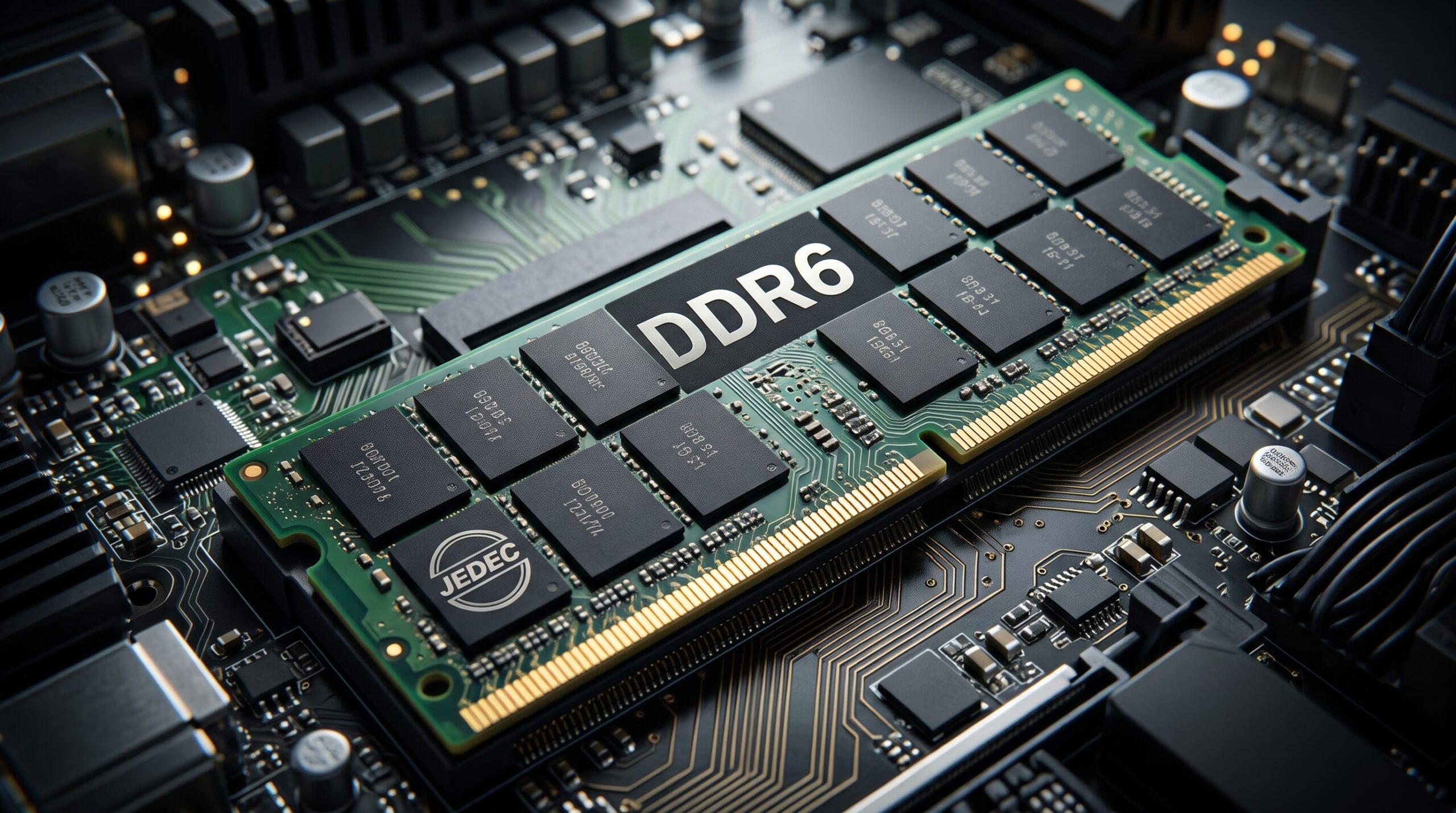
TECH – The memory industry is preparing for another major technological leap as JEDEC has officially unveiled a preview of its next-generation DDR6 DRAM standard. Designed to address the growing demands of artificial intelligence, cloud computing, and modern data centers, the upcoming technology promises substantial improvements in speed, capacity, and energy efficiency compared with existing DDR5 memory.
According to Wccftech, DDR6 memory is expected to launch with data transfer rates starting at 12,800 MT/s (12.8 GT/s), significantly exceeding the 9,200 MT/s currently supported by DDR5 RDIMMs. Future improvements could push those figures to 14,400 MT/s and beyond. JEDEC also expects the new standard to deliver more than 50% additional bandwidth at introduction, although actual application performance will depend on individual system configurations.
One of the biggest architectural changes involves the memory data bus, which will expand from 64 DQ to 96 DQ, representing a 50% increase in width. DDR6 will also introduce a pseudo-channel architecture designed to improve data movement and maximize bandwidth per DRAM package. Additionally, the number of available memory banks will double, while improved refresh mechanisms should help maintain efficiency at higher operating speeds.
Read More: TCL Unveils 10.95-Inch RGBX OLED Displays for Next-Gen Tablets
Capacity is another important area of development. DDR6 will support DRAM dies reaching up to 128 Gb, alongside optimized chip-stacking techniques that allow manufacturers to increase memory density without requiring significantly more physical space. Interestingly, the proposed module length will shrink from DDR5’s 133mm to just 74mm, potentially helping compact systems accommodate greater memory capacity.
Power efficiency and reliability are also receiving attention. Through VSS-terminated input/output technology and specialized low-power operating modes, DDR6 aims to improve performance per watt. Multiple error-correcting code (ECC) implementations are also planned to provide greater flexibility across different computing environments.
Christopher Cox, chairman of JEDEC’s JC-42 Committee, stated, “As AI and data-intensive workloads continue to drive system requirements higher, DDR6 is being designed to deliver meaningful advances in memory bandwidth, capacity, and reliability.”
Although the standard remains under development, its potential applications across servers, PCs, and AI infrastructure could reshape how future computing platforms handle increasingly demanding workloads.