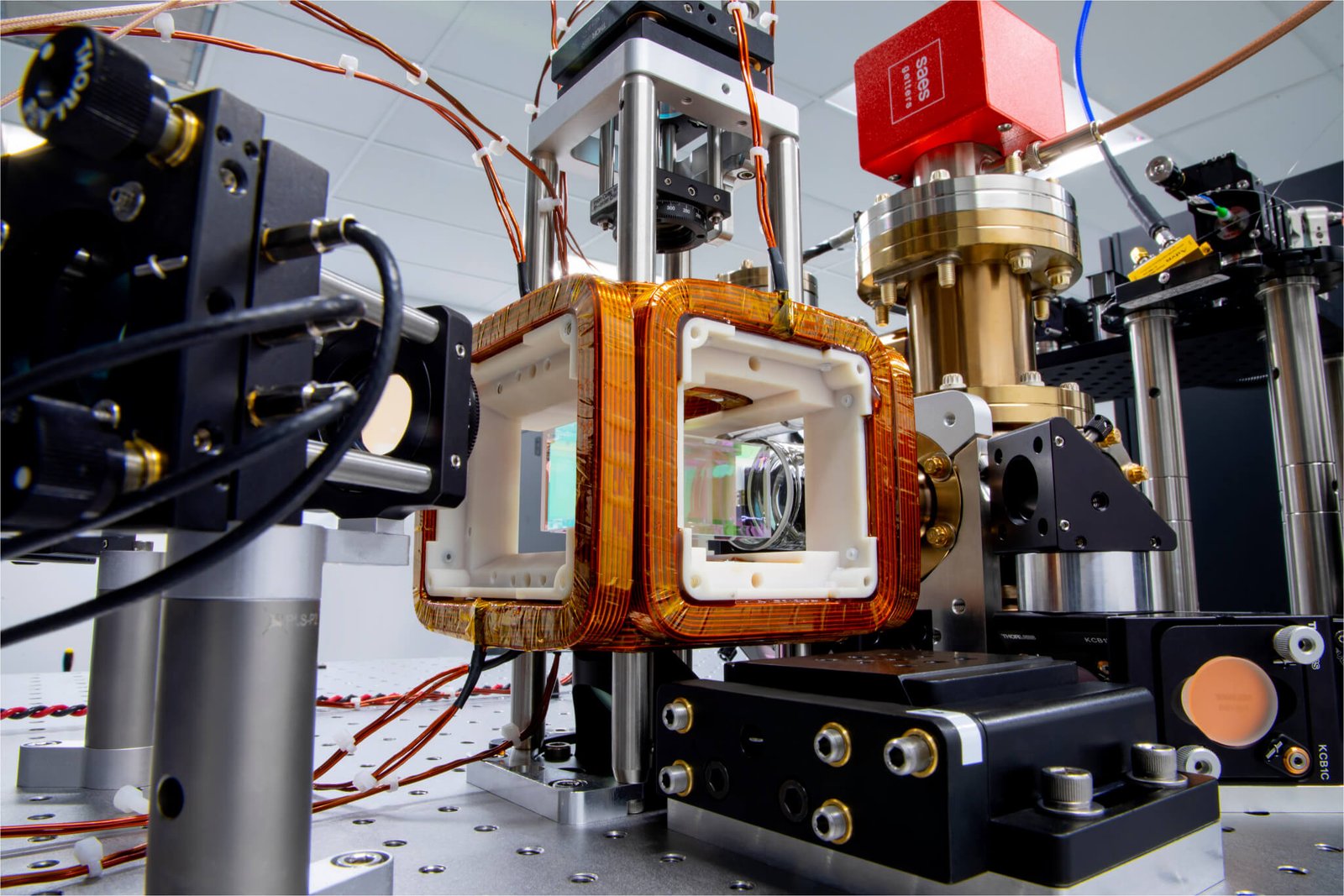
Researchers working with QuEra Computing and Lawrence Berkeley National Laboratory have reported a quantum physics study using up to 180 qubits, exploring how interacting quantum systems respond after a sudden change. Announced on 18 November alongside publication in the journal Nature, the work combines QuEra’s neutral-atom Aquila device with calculations performed using the Perlmutter supercomputer.
The development is scientifically important because many interacting quantum particles are difficult to simulate on conventional computers as their states become strongly entangled. But a successful physics experiment should not be confused with a general-purpose quantum computer that can immediately solve commercial optimisation or encryption problems.
What makes a neutral-atom system different?
A qubit is the quantum counterpart of a conventional computer bit. While a bit is represented as either zero or one, a qubit can be prepared in combinations of states that exhibit uniquely quantum behaviour. In neutral-atom systems, individual atoms are held and arranged using tightly focused laser light. Interactions between those atoms can be controlled to investigate specific physical models.
Aquila is an analogue quantum computer. Rather than executing arbitrary sequences of logic gates in the same way as a universal digital quantum processor, it is designed to reproduce and study selected quantum systems. That makes it especially useful for questions about collective behaviour, but limits what can be concluded from its results.
In the new study, the research team examined how a system evolves after its conditions are changed rapidly. One focus is the way an initially organised system may move towards a stable or thermal-like state. Understanding those processes can help physicists explain the behaviour of complex materials and the conditions under which unusual quantum effects persist.
Why researchers use a supercomputer too
Combining a quantum device with classical computing allows scientists to compare results, perform numerical calculations and test interpretations. The Perlmutter system at the National Energy Research Scientific Computing Center was used alongside the quantum experiment. This complementary approach illustrates why quantum computing research does not simply replace traditional supercomputers.
Classical simulation can become extremely demanding as a quantum system grows and entanglement increases. A programmable quantum device may provide an experimental route into regimes that are hard to describe numerically. Yet the difficulty of classical simulation depends on the exact problem and method; a high qubit count alone is not proof of universal computational superiority.
QuEra says the experiments revealed new physical behaviour connected to how quantum systems settle after changes. The independent scientific value lies in the methods and evidence presented in the peer-reviewed research, rather than in an advertised promise of immediate products.
What it could mean for materials research
Understanding quantum dynamics can contribute to the longer-term study of magnetism, exotic phases of matter and other properties relevant to future materials. Better models may eventually assist technology development, but a direct commercial application is not established merely by observing such behaviour in a laboratory.
Companies and investors following the sector should distinguish analogue simulation, fault-tolerant quantum computing and conventional high-performance computing. These approaches have different strengths, costs and levels of maturity. A result in one should not be interpreted as proof that all the obstacles facing the others have been removed.
For Asia’s research institutions and semiconductor industries, the study is relevant as evidence of continued progress in experimental quantum science. It is not a new chip product, a deployed cloud service or a demonstrated industrial cost saving.
The next steps are further independent scrutiny of the published data, replication where practical and experiments exploring whether the observed behaviour extends to other models and scales. The achievement broadens scientific understanding, which is a meaningful milestone even when immediate commercial benefits remain uncertain.
Sources and further reading
Sources: QuEra and Lawrence Berkeley National Laboratory announcement, 18 November 2026; Nature journal: original research publisher; Featured image: QuEra Computing via Wikimedia Commons, CC BY 4.0.