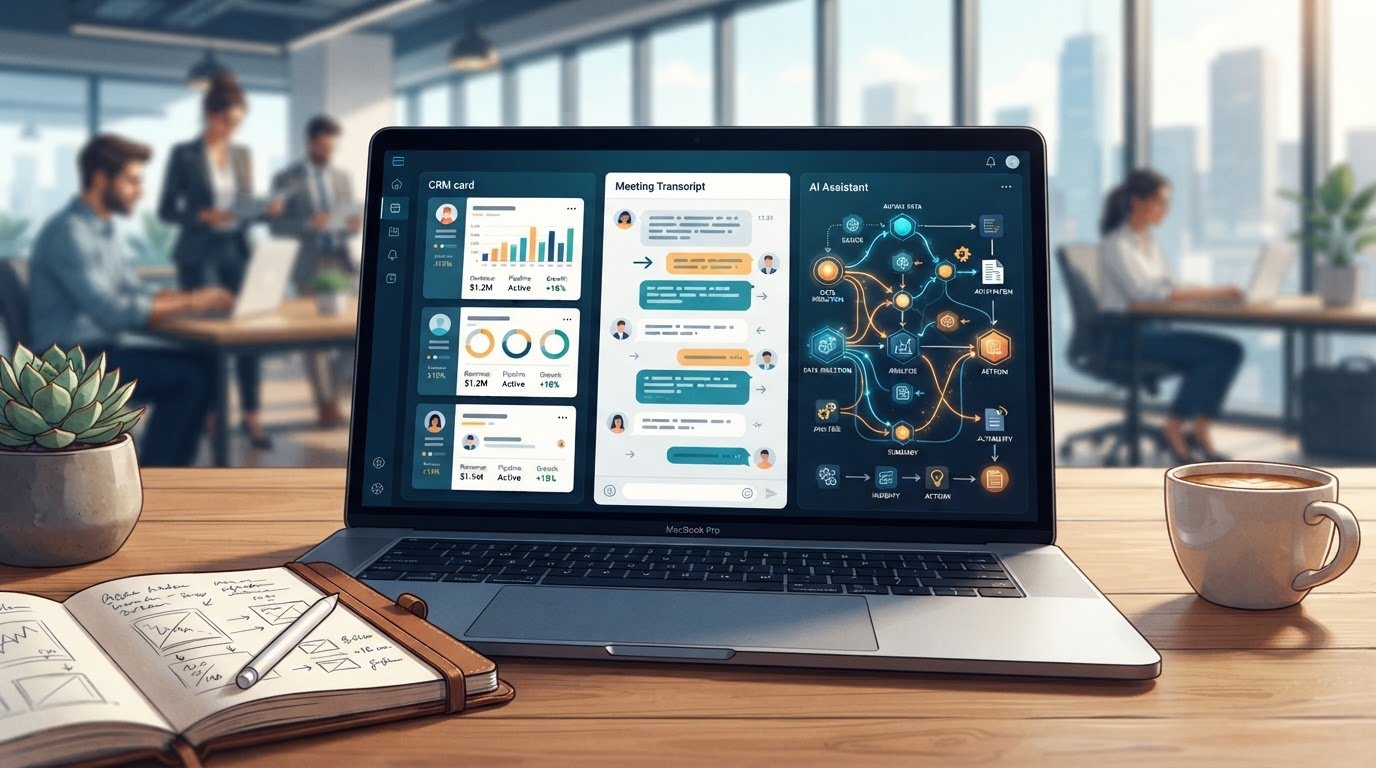
Microsoft and Salesforce have announced Copilotforce, a set of integrations intended to bring customer relationship management information directly into the workplace tools employees already use. The 17 November announcement covers Microsoft Copilot, Teams and the Fabric data platform. It signals a shift towards AI that can connect information with authorised business actions, rather than simply produce a summary or answer a question.
A salesperson, for example, might need to understand what a customer said in a meeting, what was promised by email and how that conversation relates to an opportunity recorded in Salesforce. Today those details may be scattered among different systems. The proposed integrations seek to make them available in a common workflow without asking employees to reproduce the information manually.
What is actually available?
Salesforce in Copilot has entered public preview, with more than 38 prebuilt sales skills, according to the companies. It uses authenticated access to Salesforce through Model Context Protocol, commonly known as MCP. This is a technical approach for connecting an AI assistant to tools and data; it does not mean an AI assistant gets unrestricted permission to change everything in a customer database.
The companies say Salesforce continues to control permissions for customer data and business actions, while Microsoft applies workplace security and compliance controls to its communications and documents. That division of responsibilities is essential. A tool designed to retrieve sales context should not let an employee access records they are not authorised to see simply because a conversational AI interface sits in front of them.
The companies are also connecting Salesforce Data 360 and Microsoft Fabric through what they call “Zero Copy” integrations. In principle, federated access allows an application to analyse information held in another platform without creating and maintaining a duplicate store for every query. Data federation from Microsoft OneLake into Salesforce Data 360 is generally available, while the reverse sharing direction is in public preview.
Other elements remain less widely available. Sales Cloud in Teams is currently in enterprise pilot, with an open beta planned later in 2026. Those differences matter for businesses planning deployments: a partnership announcement is not a guarantee that every listed feature can be used in a local production environment immediately.
Why joining CRM with everyday work matters
Sales teams are often measured on the quality and timing of their follow-up. Pulling together opportunity status, customer concerns and unanswered commitments could make meeting preparation faster and reduce missed handovers. The integrations may also let employees take supported actions without leaving their usual applications.
But efficiency claims should be tested against actual working conditions. Customer records can be incomplete, meeting transcripts may misinterpret speech, and AI-generated recommendations are only as dependable as the evidence they use. Businesses need human checks around commitments, pricing, legal obligations and customer communications.
Accenture is serving as a design and implementation partner and pilot customer, using the integrations in its global sales organisation. This provides a real deployment setting, though the companies have not released audited evidence establishing the precise productivity benefit for typical customers.
The implications for Singapore and ASEAN enterprises
Regional companies often operate across jurisdictions with different data-handling requirements. They should assess where information is stored, what an AI agent may access, how actions are logged and which services are available under their contracts. Data federation can reduce some duplication but cannot remove the need for governance.
Copilotforce is therefore best understood as part of a broader move from standalone AI chat tools towards embedded assistants operating inside existing business systems. Its value will depend less on the number of available skills than on whether employees can trust the data, understand the boundaries and demonstrate better customer outcomes.
Sources and further reading
Sources: Microsoft and Salesforce joint release, 17 November 2026; Microsoft Copilot product updates.