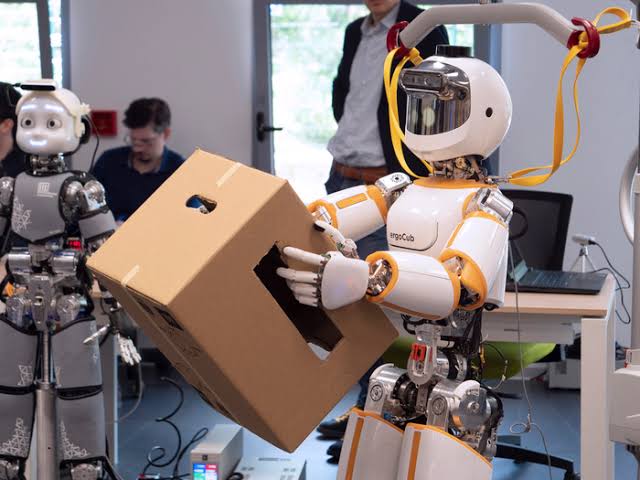
TECH – Lifting heavy objects alongside a machine that actually senses your fatigue might sound futuristic, but researchers in Italy and the United Kingdom have just made it real. As reported by Interesting Engineering, scientists from GenerativeBionics, the Italian Institute of Technology, and the University of Manchester have built a humanoid robot named ergoCub that adjusts itself in real time to match a human partner’s movements during shared lifting tasks, all in an effort to cut down on workplace injuries.
What makes ergoCub different from typical humanoids isn’t just its software, it’s how the entire robot was conceived from the ground up. Most robots get built in two disconnected phases: engineers lock in the hardware first, then write software afterward to patch around whatever mechanical shortcomings show up later. This team flipped that order entirely, designing the robot’s limbs, sensors, actuators, and control systems all at once, while treating the human working alongside it as part of the same system rather than an external variable.
That design philosophy, which the researchers call shared embodied intelligence, means ergoCub isn’t just executing pre-programmed motions. It builds a live, evolving model of whoever it’s lifting with, using that model to predict their movements, sync its own actions accordingly, and adapt to people of different sizes and strength levels on the fly. During testing, the robot tracked a crucial stress point, the torque on a person’s lower back, and adjusted its own force output to meaningfully lessen that strain compared to a person lifting solo.
Read More: Kimi K3 Runs on 8GB RAM Without a GPU Thanks to C99
The benefits weren’t limited to teamwork either. Engineering the robot this holistic way also made ergoCub itself faster and more energy-efficient at walking than earlier versions built the traditional way, suggesting that merging body and brain design pays off even outside collaborative settings.
The team hasn’t stopped at ergoCub. They’ve already carried this same approach into Gene.01, a newer humanoid platform designed to be modular enough for industries ranging from manufacturing and logistics to shipbuilding and healthcare, swapping out sensors, AI models, and grippers depending on the job. If this approach catches on, the line between robot and coworker may blur even further, one lift at a time.