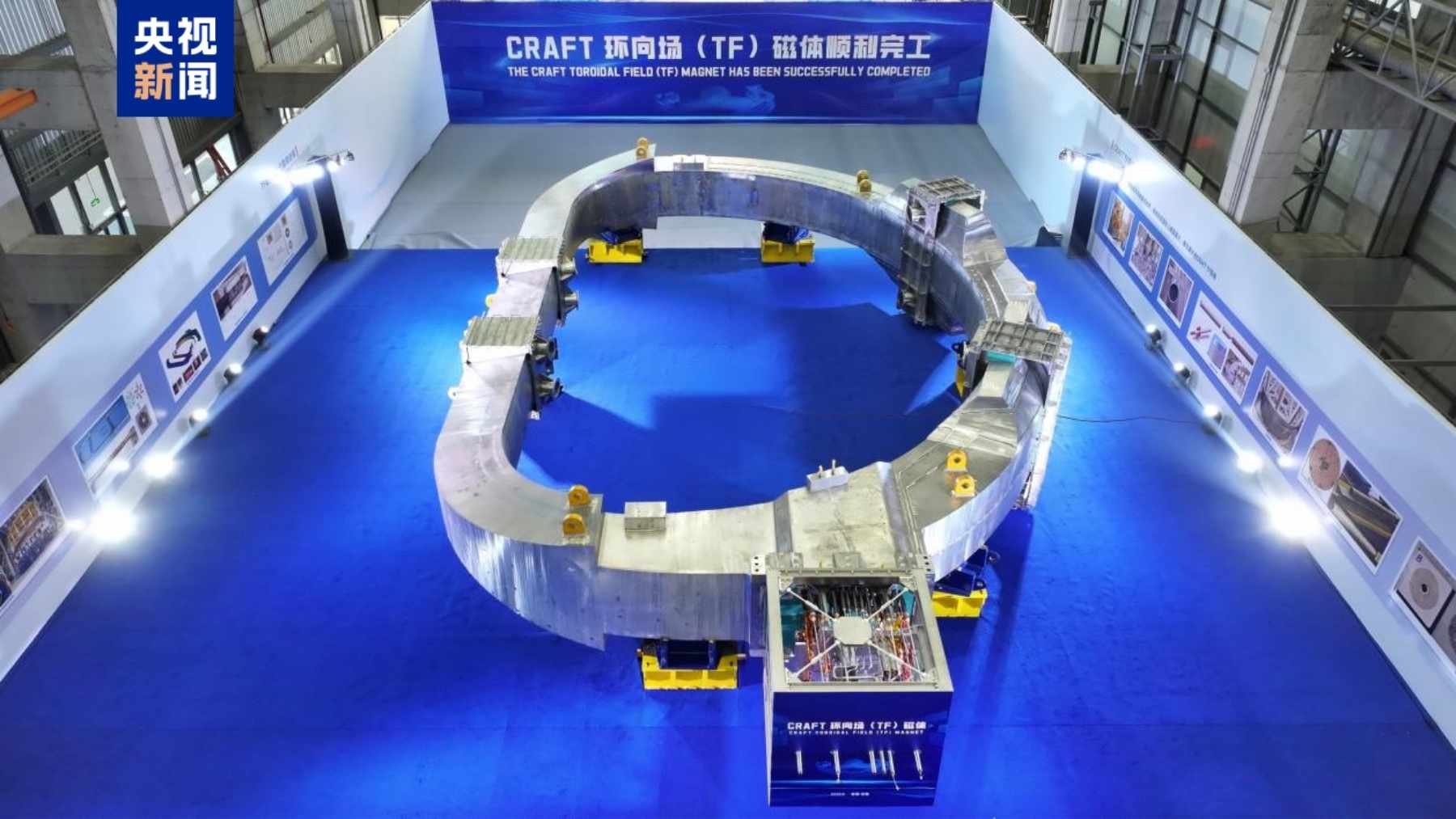
TECH – China has completed a massive magnet that could play a crucial role in the country’s ambitious pursuit of nuclear fusion energy, marking another significant milestone in the effort to build an “artificial Sun.” According to India Today, the 582-tonne device is reportedly the world’s largest pulsed magnet and has been developed for the China Fusion Engineering Test Reactor (CFETR), a proposed facility designed to advance fusion technology toward practical energy production.
The enormous magnet, known as a pulsed high-field magnet, is engineered to generate an exceptionally powerful magnetic field. Such technology is essential for fusion research because scientists must confine superheated plasma inside a reactor without allowing it to come into contact with the surrounding walls. The plasma must reach temperatures of more than 100 million degrees Celsius, creating an environment far hotter than the core of the Sun.
The magnet was developed by Chinese researchers and engineers as part of the country’s broader effort to strengthen its position in the global fusion race. According to India Today, the device is expected to support future experiments involving high-temperature plasma and help researchers investigate the complex conditions required to sustain controlled nuclear fusion reactions.
Fusion seeks to replicate the process that powers stars. Instead of splitting heavy atoms, as conventional nuclear fission reactors do, fusion combines light atomic nuclei under extreme conditions, releasing enormous amounts of energy. Scientists view the technology as a potentially cleaner energy source because it does not produce the same level of long-lived radioactive waste associated with traditional fission.
Read More: UK Backs Vertical Aerospace in Electric Aircraft Charging
The completion of the giant magnet is particularly important because controlling fusion plasma remains one of the greatest scientific and engineering challenges. Powerful magnetic fields can help stabilize and confine the plasma, preventing it from escaping and allowing researchers to maintain the conditions necessary for fusion.
Although the report did not include a direct quotation from a project official, the completion of the magnet demonstrates the scale of China’s investment in advanced fusion infrastructure. The country has already developed several major experimental facilities and continues to expand research into magnetic confinement technology.
As reported by India Today, the 582-tonne magnet represents more than an impressive feat of engineering. It is part of a much larger effort to turn nuclear fusion from a scientific dream into a practical energy technology. While the road toward commercially viable fusion power remains long and technically demanding, China’s latest achievement provides another powerful indication that the global race to harness the energy of the stars is gathering momentum.