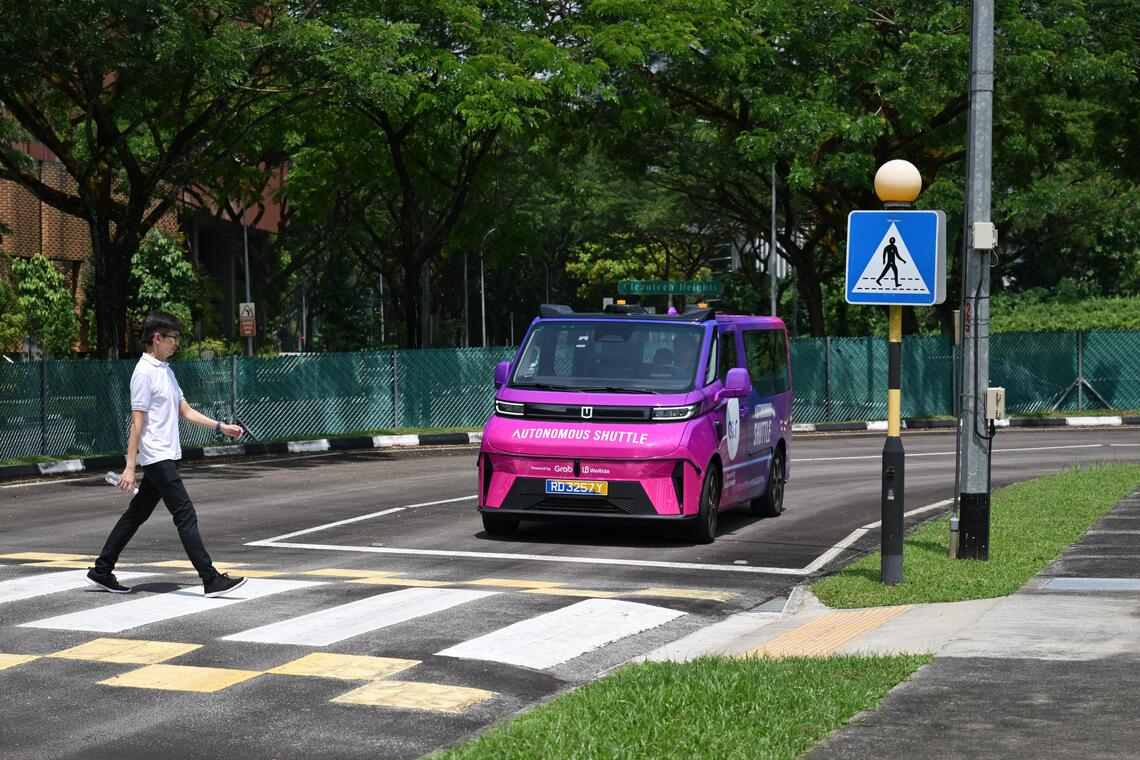
SINGAPORE – In Singapore, any autonomous vehicle intended for public roads undergoes a rigorous validation process to ensure safety, reliability, and local adaptability. The Land Transport Authority (LTA) and the Centre of Excellence for Testing & Research of Autonomous Vehicles (CETRAN) are jointly responsible for overseeing these trials. The testing regime unfolds in staged “milestones” before a vehicle can be issued final approval to operate in public environments.
Sourced from The Straits Times, the first step in this evaluation is Milestone One, which takes place in a controlled test circuit at Nanyang Technological University (NTU). There, autonomous vehicles must successfully complete a series of basic manoeuvres that mirror real-world driving conditions. These tasks include obstacle avoidance, emergency braking, lane keeping, and reaction to unexpected events. The circuit is designed to simulate Singapore’s urban roads as closely as possible, with traffic signs, intersections, and variable road layouts.
Passing Milestone One grants limited authorisation to proceed to public trials. However, not every vehicle that undertakes the circuit test is immediately advanced. Authorities assess whether the vehicle’s responses are reliable, consistent, and safe under edge cases before allowing further exposure.
To date, more than 50 authorisations for autonomous vehicle testing have been granted since 2017, and about 19 vehicles are currently permitted to operate in certain public settings. The LTA continues to monitor their performance closely, gathering data on real-world interactions, system reliability, and compliance with traffic norms.
Read More: Rising Costs, Staff Shortage, Competition Drive Singapore F&B Closures
A single run through the NTU circuit can take approximately five hours, which allows evaluators to subject the vehicle to a range of conditions and stimuli during one continuous session. This duration ensures that systems are tested under varying loads, sensor inputs, and environmental conditions.
The multi-milestone approach also incorporates simulation phases and virtual assessments. Before physical trials, developers are often required to validate their systems through simulation, where thousands of virtual scenarios—including rare or extreme events—can be tested safely and repeatedly. These simulations help identify failure modes and calibrate system behavior before risking real vehicles on roads. (Supporting methodologies align with Singapore’s Simulation Assessment Guidelines for independent safety assurance)
Only after a vehicle demonstrates safety across controlled track tests, simulation, and initial real-road trials can it obtain a full licence to run under broader public conditions. Throughout the process, regulators, developers, and researchers collect extensive data on system performance, fault rates, human interactions, and environmental robustness.
Singapore’s graduated, multi-layered testing framework reflects its cautious but forward-looking approach to deploying autonomous vehicle technology. By combining physical circuit tests, simulation, and real-world trialling, the country seeks to ensure that self-driving systems are mature, dependable, and ready for public roads before full deployment.