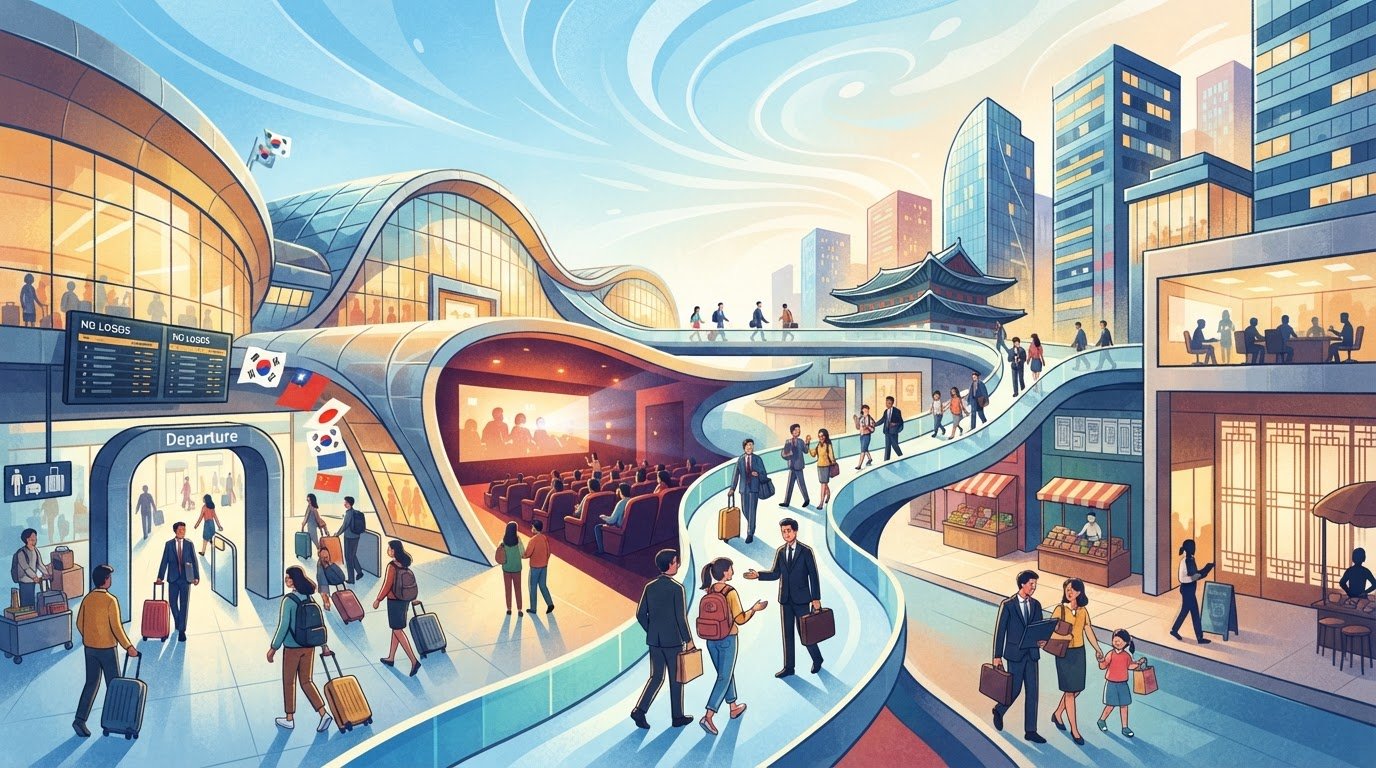
South Korea and China have reached a substantive conclusion to nearly nine years of follow-up negotiations on services and investment under their free trade agreement, opening the prospect of greater market access for Korean entertainment, tourism and professional services. The announcement followed a meeting between South Korean President Lee Jae Myung and Chinese President Xi Jinping on the sidelines of the APEC summit in Shenzhen on 18 November.
The breakthrough matters because services do not move across borders as visibly as manufactured goods. Films, video games, legal advice, tourism packages, financial services and retail operations depend heavily on licensing, local regulations and access to customers. Reducing barriers in these sectors can have commercial effects even without changing tariffs on physical products.
What has been agreed in principle?
South Korea’s trade ministry said the two governments had substantially completed the negotiations, although some technical drafting work remained. Under the proposed arrangements, China will provide most-favoured-nation treatment for Korean films and games, meaning Korean suppliers should not receive less favourable treatment than comparable suppliers from other countries under the covered provisions.
Beijing also agreed to apply non-discrimination principles in reviews of Korean film and online game content. The countries intend to expand opportunities for joint productions, including television programmes, and to open additional routes for tourism and other service providers. South Korean travel agencies are expected to gain the ability to arrange outbound tours in 23 specified Chinese regions.
Those announcements should be understood as the substance of a negotiated deal, not proof that every new market-access rule has already taken effect. The full legal text, formal signing, domestic processes and implementation details will determine when companies can use each provision.
Why entertainment is a sensitive part of the deal
Korean television, music, film and gaming companies have strong international audiences, but access to China has been politically sensitive for years. Relations became strained after South Korea’s deployment of a US missile defence system in 2016, which Beijing opposed. Observers have linked subsequent restrictions on some Korean cultural content to that dispute, although Chinese authorities have not formally characterised them in exactly those terms.
The new commitments could provide a more predictable basis for Korean suppliers seeking Chinese customers. Yet formal non-discrimination principles will matter only if companies can see consistent regulatory decisions and workable licensing procedures. Market access can remain limited by standards, commercial competition and consumer preferences even after a bilateral announcement.
Tourism offers another channel. Travel businesses, hospitality companies, airlines and related services stand to benefit from smoother two-way demand, provided the agreement’s practical provisions allow firms to establish and sell services as expected. Actual gains will depend on consumer spending and the wider diplomatic climate.
What this means for Asian businesses
For ASEAN firms, the agreement illustrates how trade negotiations increasingly target regulation and services rather than just the movement of goods. Businesses in Singapore that work with Korean media, tourism or cross-border services may follow these changes for partnership opportunities. There is, however, no evidence yet that the agreement will directly raise revenue for particular Singapore companies.
The two governments have also discussed cooperation beyond entertainment, including legal and financial services. These sectors are more heavily regulated and may require time to clarify professional qualifications, local establishment requirements and the scope of permitted activity.
The agreement’s political symbolism is substantial after prolonged talks, but its business success will depend on the details. Investors should monitor publication of the final text, the signing timetable, regulators’ implementation guidance and evidence of actual services trade growth. A diplomatic breakthrough can open a door; it takes predictable rules to let businesses walk through it.
Sources and further reading
Sources: South Korea Ministry of Trade: official 18 November statement (Korean); Yonhap: agreement details; Reuters: business implications.