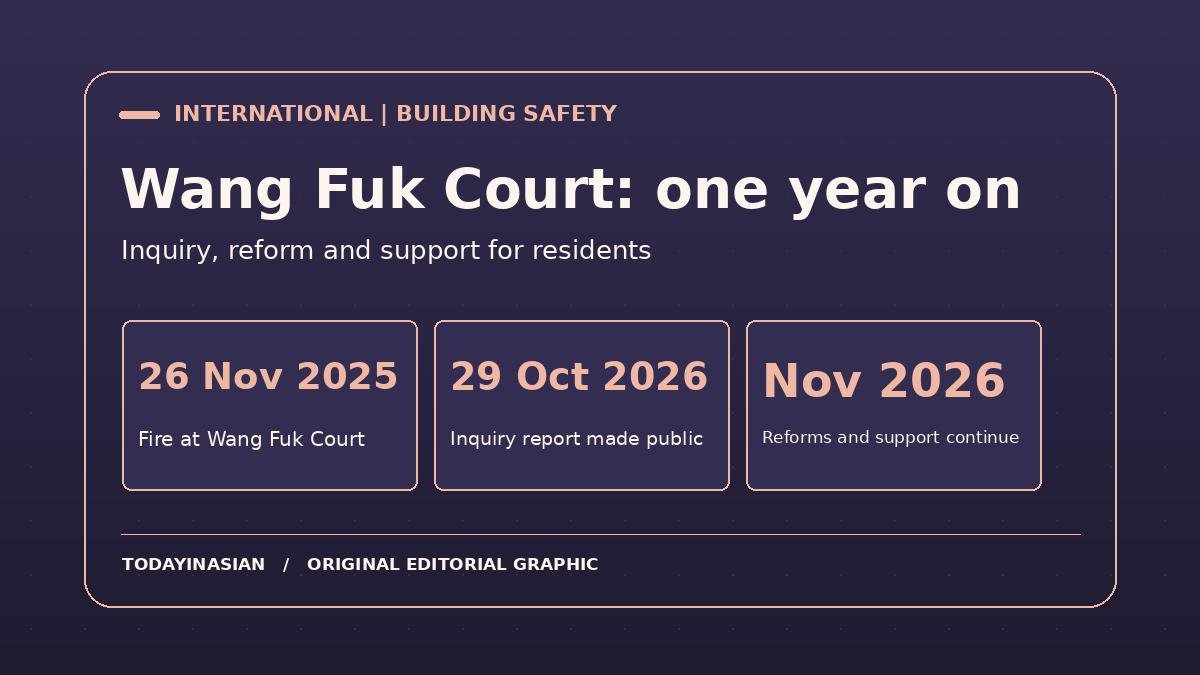
INTERNATIONAL,- Hong Kong has marked one year since the fire at Wang Fuk Court, the Tai Po housing estate where 168 people died on 26 November 2025. A public inquiry has finished its work and the government has begun preparing reforms. For residents who lost relatives or homes, the fact that a report has been published does not resolve the needs that follow displacement.
The Independent Committee’s published report sets out what it found about the fire and the building works under way at the estate. The government published the report on 29 October 2026. In a November update, the administration said departments were advancing changes based on the recommendations and had been asked to expedite proposed legislation and improve oversight. Proposals and progress reports are distinct from new rules that have taken effect.
Reform has to reach the worksite as well as the rulebook
Renovation of occupied residential buildings involves decisions by contractors, managers, owners and regulators. A rule can address what materials are allowed, but someone also has to verify what arrives and make sure any replacement meets the same requirements. Paper trails are useful where they let inspectors trace responsibility and owners report concerns; they are less effective where checks are easy to bypass in routine work.
Implementation should be judged by evidence that is visible outside government. This could include the progress of proposed legislation, the inspection process used for ongoing renovation projects, and how complaints are recorded and followed up. It also means saying which changes apply to existing projects rather than assuming all sites switch over at once.
Residents’ recovery has its own timetable
The Associated Press reported around the anniversary that survivors continued to face grief and uncertainty. Policy trackers can count support programmes, property transfers and other administrative milestones, but those numbers cannot on their own indicate whether affected households have a stable place to live or access to continuing care. Publishing milestones separately for building safety and resident support would make it easier to assess what each part of the response is achieving.
Cities elsewhere in Asia with ageing high-rise housing face a related question: how to carry out major repairs without losing sight of the safety of people still living inside. The Hong Kong case does not show that every city needs identical rules. It does show why inspection on site, clear responsibilities and a way for residents to raise issues are as important as the standards written down.
Original editorial graphic by TodayinAsian. Sources: Independent Committee report archive and Hong Kong government updates. This is a timeline, not an image of the incident.