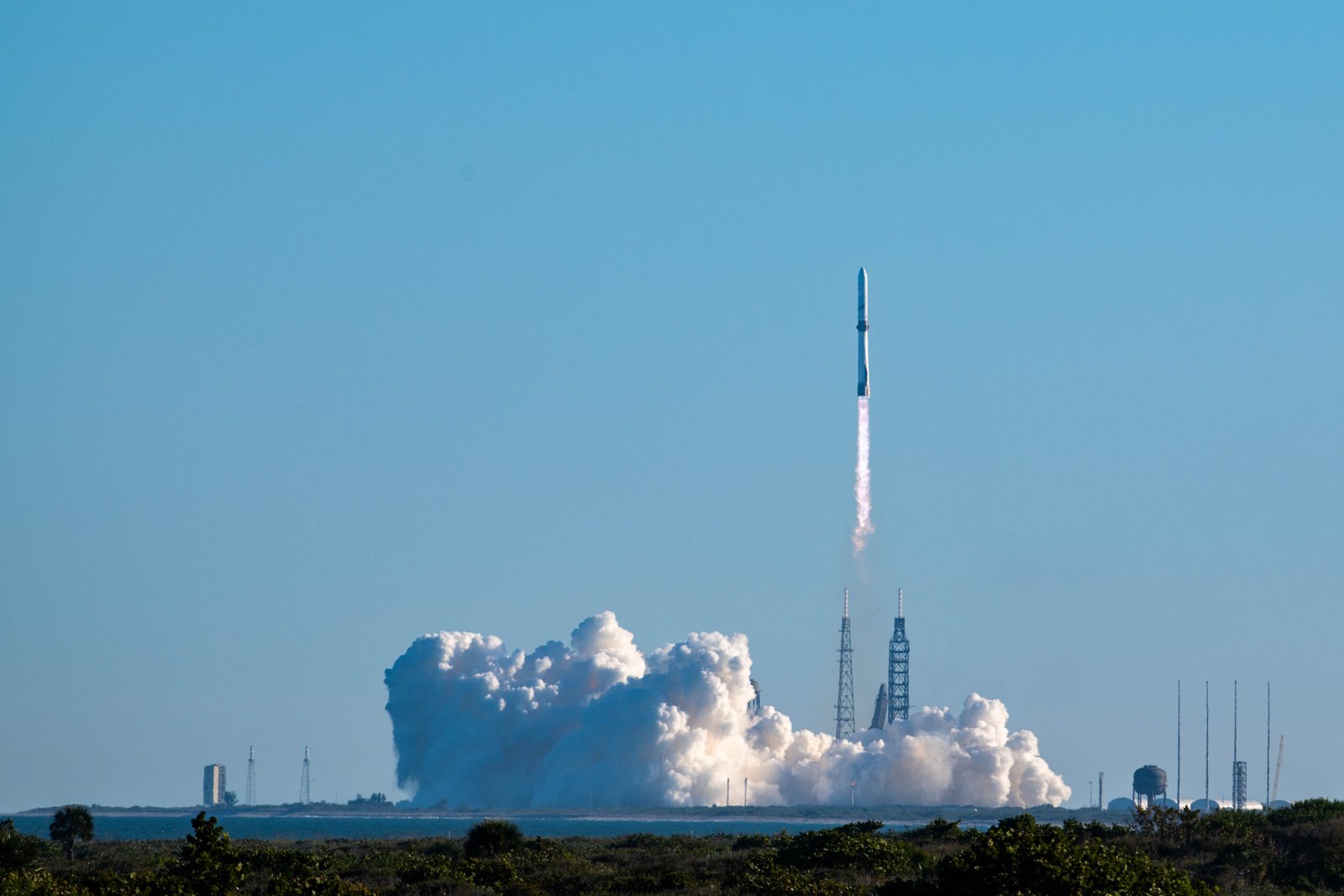
TECH,- Google has selected Blue Origin’s New Glenn rocket for an experimental launch that could help determine whether artificial intelligence computing can operate reliably in space. The mission is targeted for the first quarter of 2029 under Google’s Project Suncatcher. The idea is to use solar power available in orbit and potentially relieve some pressure on Earth’s electricity and cooling resources, but commercial space-based data centres remain a distant and technically difficult prospect.
The company announced its partnership on 19 November, and Reuters reported that several satellites would be carried by New Glenn. Each satellite is intended to contain Google’s tensor processing units, or TPUs, with computing capacity roughly comparable to a conventional data-centre rack. That comparison concerns planned processing capability, not a claim that an entire ground data centre can already be replaced.
Why put AI chips in orbit?
Training and operating advanced AI models requires powerful computing equipment and considerable energy. Land-based data centres need reliable electricity, network connections, cooling and suitable locations. Google is exploring whether solar power in orbit could eventually support some computation with less dependence on local terrestrial resources.
Solar availability is attractive in certain orbits, but sunlight is only one part of the calculation. Satellites must survive launch forces, radiation and temperature changes, and they need a way to reject heat into space. Without air to carry heat away, spacecraft rely heavily on conduction to radiators and thermal radiation. Powerful chips can generate significant heat, so thermal engineering may become a central constraint.
A distributed orbital system also needs fast, reliable communications. Moving large datasets between Earth and satellites can be expensive in bandwidth and latency, and synchronising multiple spacecraft adds complexity. These problems differ from simply sending a weather sensor into orbit.
What Google has tested so far
Google says early hardware has been launched with Planet Labs to examine chip resilience and other operational questions. The planned Blue Origin mission would be a more substantial heavy-lift test. It is still experimental: the announcement does not describe customers buying commercial AI compute from orbit or specify when such a service could become economically viable.
The timing also matters. A first-quarter 2029 mission target is more than two years away, and rocket programmes can experience delays. New Glenn must provide the launch capacity and mission requirements, while Google and its partners must build and qualify the satellites.
Can space computing ever be cheaper?
The economic case depends on launch prices, spacecraft manufacturing, maintenance, replacement cycles and the cost of transmitting data. Ground-based data centres benefit from an established supply chain and easy physical access for repairs. A damaged server in orbit is not nearly as simple to replace.
The concept may have advantages for specialised tasks where computing near an orbital sensor reduces the amount of data sent down to Earth. But extending that advantage to general-purpose AI services would require substantial evidence about performance, energy economics and reliability. Solar power alone does not resolve those requirements.
Why the experiment matters now
As AI demand grows, infrastructure developers are exploring unconventional locations and energy arrangements. Undersea and remote terrestrial facilities have also been proposed or tested. Orbital computing is a more radical extension of that search, raising technical as well as environmental and space-traffic questions.
The immediate news is a specific future launch partnership and a defined research direction. The broader question is whether orbital hardware can deliver sufficient computing value to justify the cost and risk. Google and Blue Origin now have a mission to test part of that premise; claims of an imminent revolution in AI infrastructure would go well beyond the evidence.