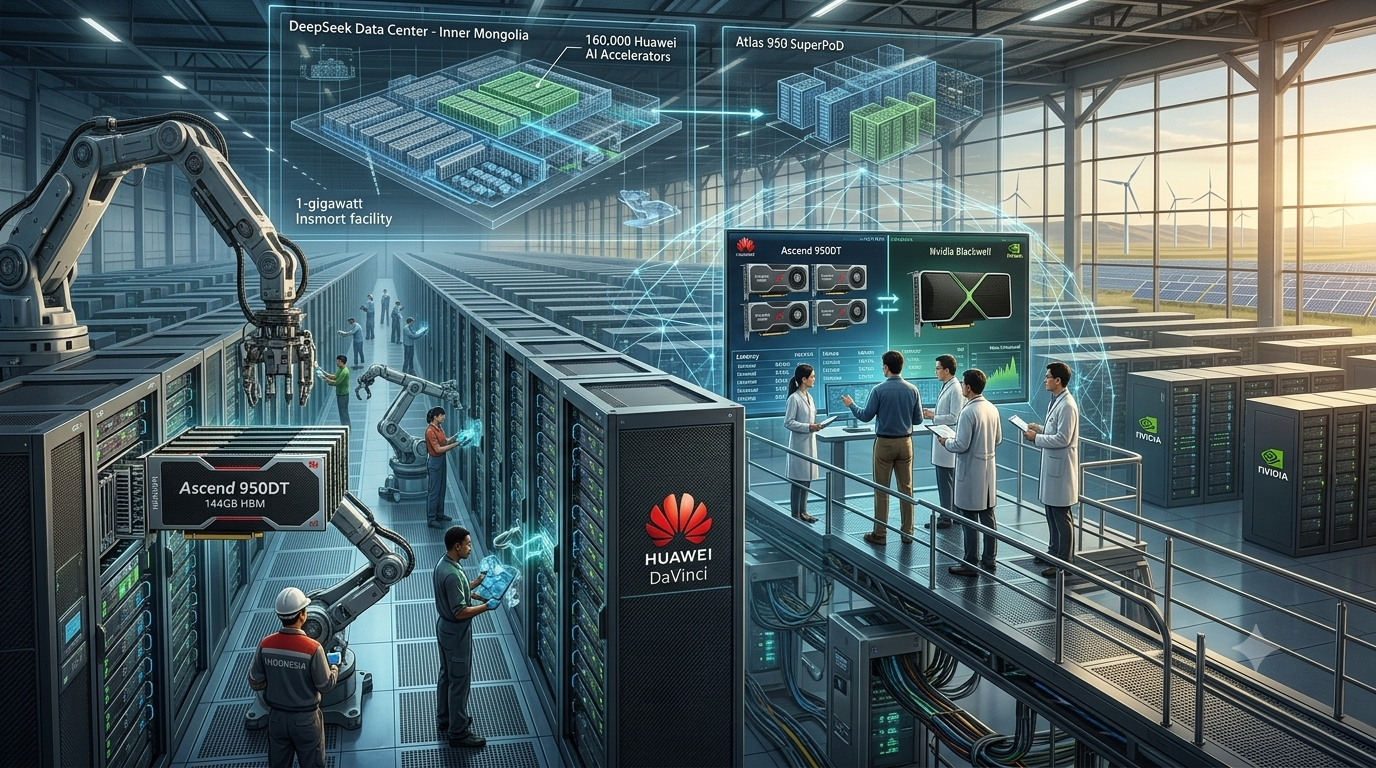
TECH – Nvidia’s grip on China’s artificial intelligence market is facing another serious challenge as DeepSeek reportedly prepares to deploy 160,000 Huawei AI accelerators at a massive data center in Inner Mongolia. According to Wccftech, citing a Bloomberg report, the move could become one of the largest known deployments of Huawei AI chips and further strengthen China’s push to reduce its dependence on Nvidia.
The chips in question are Huawei’s next-generation Ascend 950DT processors, which DeepSeek reportedly plans to use primarily for running AI models rather than training them. The facility is being developed at roughly a 1-gigawatt scale, although the 160,000 accelerators would represent only part of its planned computing capacity. Bloomberg-based reporting also indicates that DeepSeek continues to rely on Nvidia hardware for the more demanding training workloads.
The scale of the order is striking. Wccftech estimates that 160,000 Ascend 950DT chips could be worth around $2.56 billion based on a reported price of approximately 111,000 yuan, or $16,000, per chip. Nvidia’s H20, meanwhile, has reportedly been priced between $15,000 and $25,000. The decision therefore appears to involve more than simply choosing the cheaper processor.
Read More: Yangwang U7 Survives 30,000km Extreme Battery Test
Huawei’s 950DT is built around the company’s DaVinci architecture and reportedly features 144GB of high-bandwidth memory, 4TB/s of memory bandwidth and a 2TB/s chip-to-chip interconnect. Huawei says its larger Atlas 950 SuperPoD can connect up to 8,192 Ascend 950DT processors, illustrating the scale of infrastructure the company is targeting.
The development also echoes comments from DeepSeek CEO Liang Wenfeng earlier this year. He argued that Huawei’s systems could perform the same tasks as Nvidia’s GB300 in terms of latency, although he acknowledged that four Huawei GPUs were needed to match one Nvidia GPU and that Huawei remained roughly two years behind.
For Nvidia, the problem is not simply performance. US export restrictions have limited which advanced processors can reach China, while Beijing has increasingly encouraged domestic alternatives. DeepSeek’s reported decision gives Huawei another major opportunity to improve its ecosystem, production scale and software compatibility.
That is why Wccftech’s report describes China as potentially becoming a “lost cause” for Nvidia. The phrase is an assessment rather than an official Nvidia position, but the direction of China’s AI hardware market is becoming increasingly difficult for the American chipmaker to ignore.