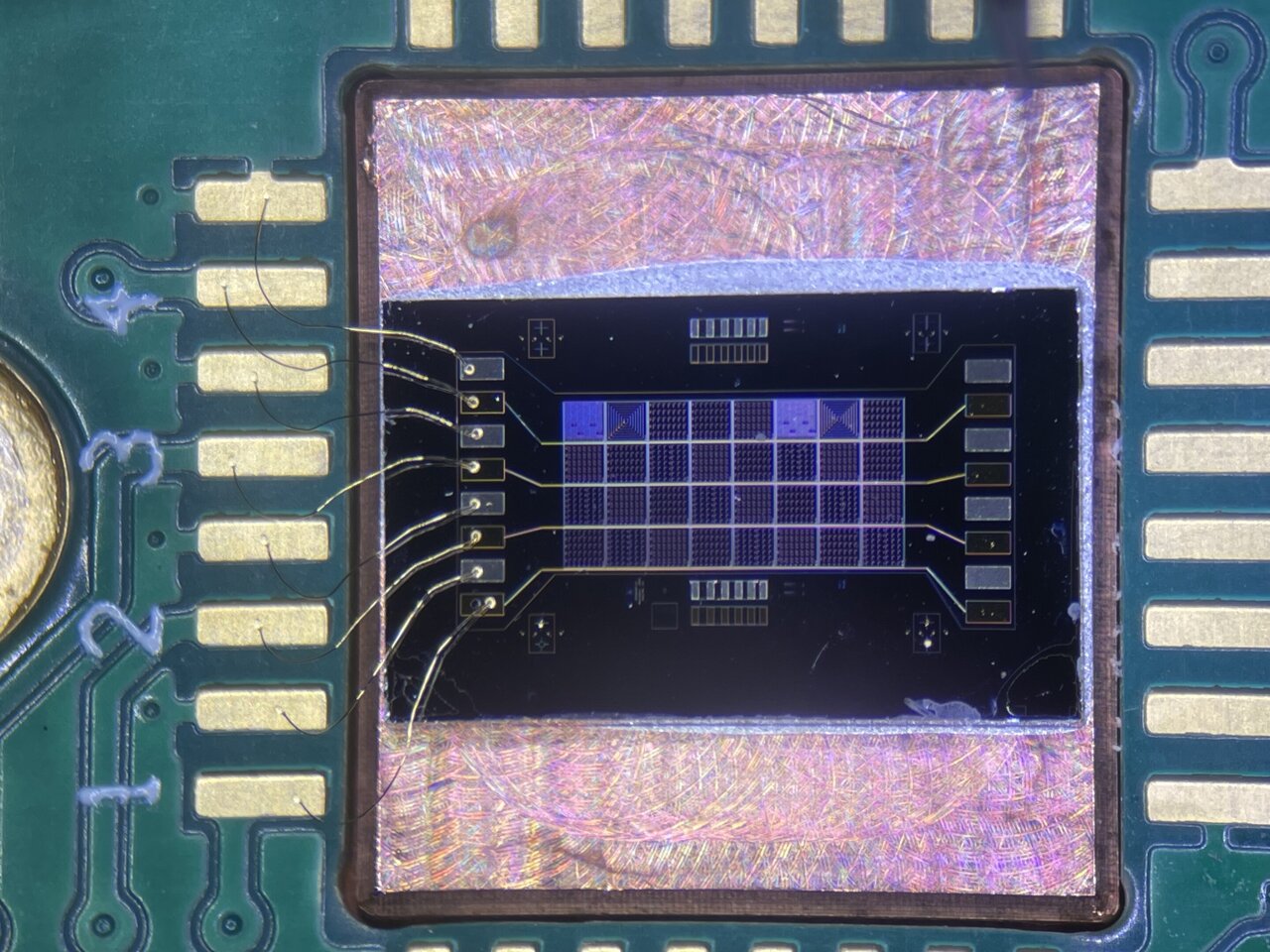
TECH – A team of international researchers has unveiled a breakthrough quantum light source that could accelerate the development of ultra-secure communication networks and future quantum technologies. As reported by Tech Xplore, the newly developed device is a quantum dot–based photon emitter that operates directly in the telecom O-band, making it compatible with existing fiber-optic infrastructure without requiring complex frequency conversion.
The innovation comes from scientists at the University of Copenhagen’s Niels Bohr Institute, along with collaborators from Ruhr University Bochum, the University of Basel, and Sparrow Quantum ApS. Their goal was to create a photon emitter that combines high brightness, strong quantum coherence, and telecom compatibility—three features that have rarely been achieved together. According to the article on Tech Xplore, the device emits over 40 million single photons per second while maintaining exceptional consistency.
Quantum dots, tiny semiconductor structures that confine electrons like artificial atoms, serve as the heart of the system. When stimulated by a laser, each quantum dot releases one photon into a nanophotonic waveguide.
Read More: MIT Revives 40-Year-Old Shape-Shifting Zipper Idea
The researchers embedded the dots within a carefully engineered p-i-n diode structure to stabilize electrical noise, ensuring that consecutive photons remain nearly identical. As first author Marcus Albrechtsen explained in comments quoted by Tech Xplore, the team aimed to “connect a premier quantum light source with the optical technology we already know how to scale,” emphasizing the importance of direct telecom-band operation.
To enhance performance, the researchers also designed a photonic crystal waveguide around the quantum dots. This structure strengthens photon emission through the Purcell effect, improving efficiency while reducing environmental disturbances that could disrupt coherence. The result is emission lines only about 8% broader than the theoretical lifetime limit—an impressive indicator of quantum stability. Albrechtsen noted that more than 92% of the emitted photons are nearly identical, a critical requirement for practical quantum communication systems.
Beyond laboratory success, the technology could support scalable quantum networks, secure data transmission, advanced sensing applications, and potentially even fault-tolerant quantum computers. Principal investigator Leonardo Midolo highlighted that the new approach removes the need for filtering out mismatched photons, significantly improving efficiency. The next step involves integrating multiple emitters on a single chip, paving the way toward large-scale quantum photonic circuits and, ultimately, elements of a future quantum internet.