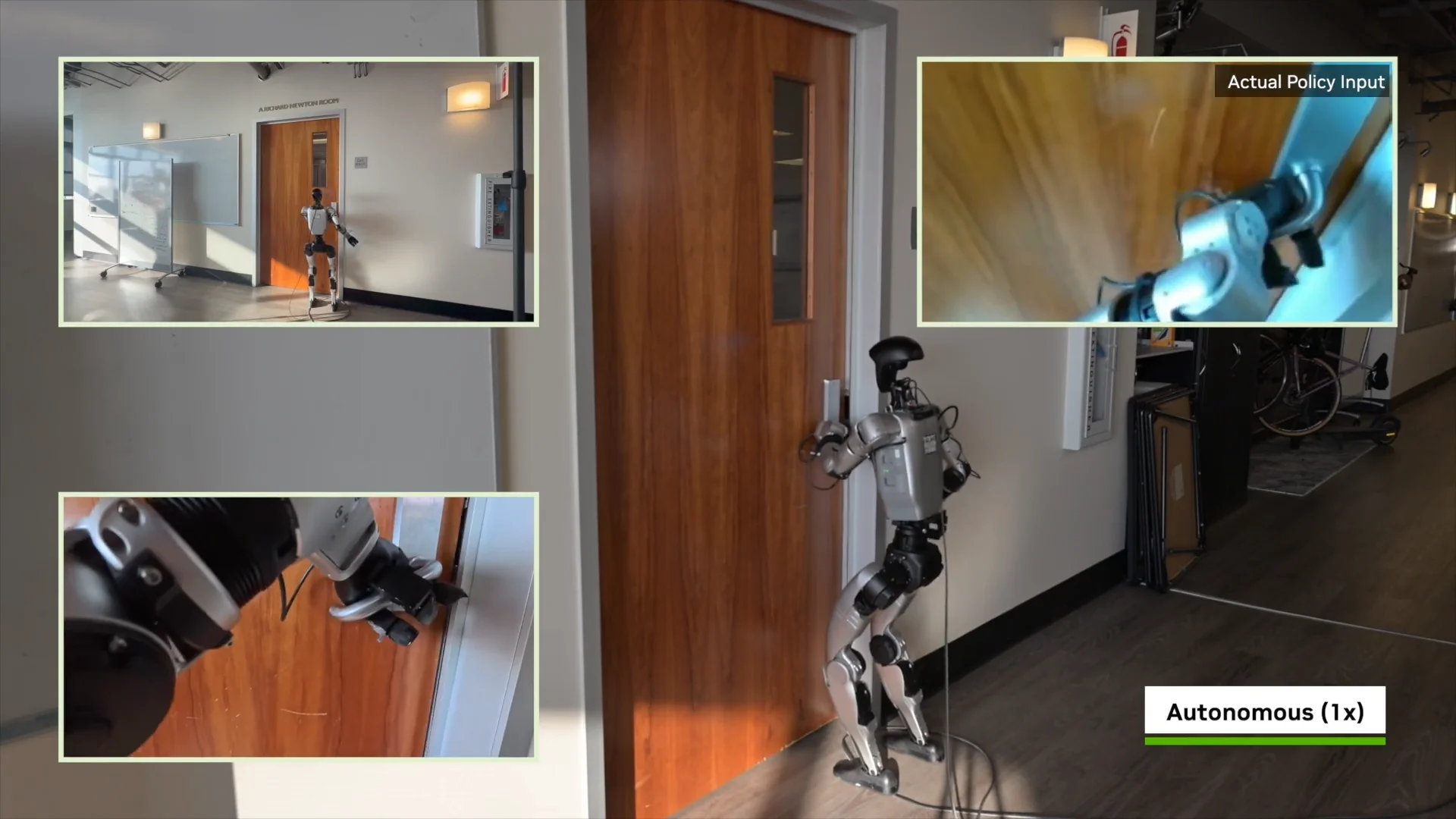
TECH – A new breakthrough from NVIDIA reveals a robotic learning system dubbed DoorMan that empowers a humanoid robot to open doors more quickly and reliably than human operators. In tests on the $16,000 Unitree G1, DoorMan relied solely on built-in RGB cameras and avoided traditional crutches like depth sensors or motion-capture markers.
In real-world trials, the robot using DoorMan beat experienced human tele-operators completing door-opening tasks up to 31% faster and achieving a higher success rate overall. What’s fascinating is that the robot perceives raw pixel data, thinks, plans, and acts all autonomously no extra calibration needed. The approach is built around a “pixel-to-action” reinforcement learning policy, trained entirely within NVIDIA’s Isaac Lab simulation environment and deployed “zero-shot” on real hardware.
Training such a system wasn’t easy. To overcome the usual stumbling block of “exploration” where a robot learning from scratch might flail forever without finding the right sequence, the team used a clever “staged-reset” technique. Whenever the simulated robot achieved a mid-task milestone, like grabbing the handle, that state was saved and used to begin subsequent trials. This allowed the system to skip redundant learning and focus on mastering the harder parts, like swinging the door open and walking through it.
Read More: Volkswagen’s Numa Concept Reimagines Cars for Cities
Another challenge: once the robot got close enough, the handle might slip out of view. To tackle this, the developers included a method called Group Relative Policy Optimization, which nudges the robot to subtly adjust its posture or head angle, keeping the handle visible while continuing the movement.
Rather than only training on one door, the simulation exposed the system to a “multiverse” of possibilities dozens of door types, hinge stiffnesses, handle shapes, textures, and physical dynamics, so that the real world would feel like just another variation.
With an 83% success rate, DoorMan edged out expert human operators (80%) and dwarfed inexperienced controllers (60%). This represents a major leap in “loco-manipulation” a very demanding class of robotics tasks that requires simultaneous locomotion, perception, and manipulation.
DoorMan shows that advanced robotics doesn’t always mean cutting-edge sensors or perfect lab conditions, with clever training and smart simulation, a relatively inexpensive humanoid robot can do what humans do sometimes faster and more consistently.