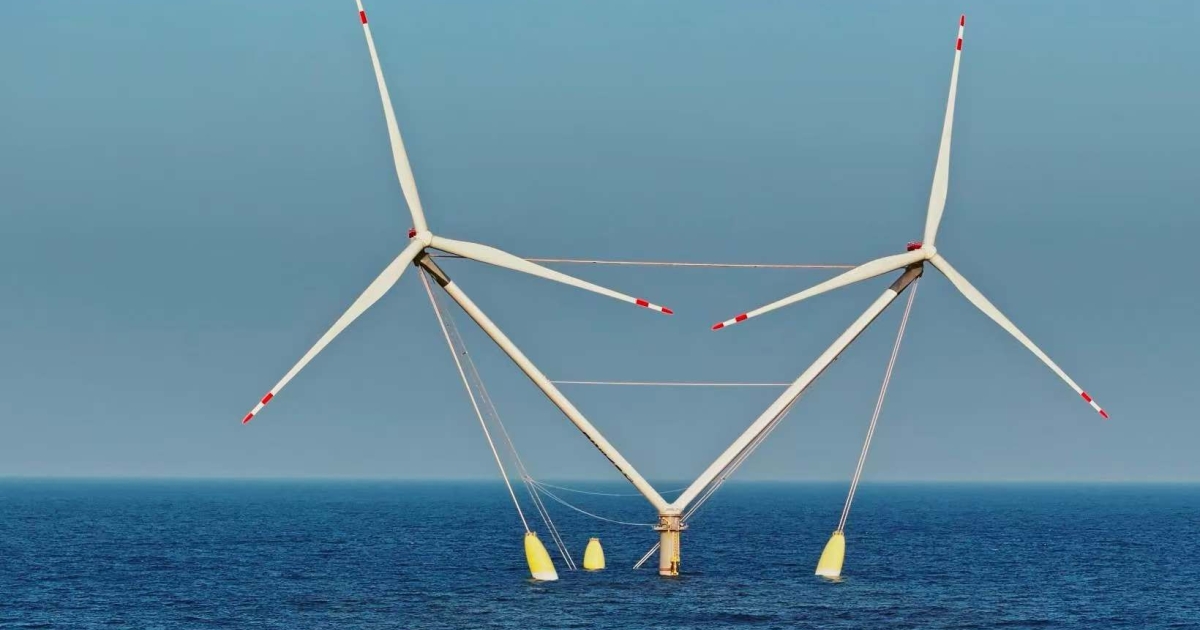
TECH – China has introduced what is being described as the world’s first floating offshore wind platform designed to support a single 16-megawatt wind turbine, marking another significant milestone in the country’s renewable energy ambitions. According to Interesting Engineering, the innovative platform was jointly developed by China Huaneng Group’s Clean Energy Research Institute and Dongfang Electric Corporation. The project aims to unlock the enormous wind resources available in deep-sea regions, where stronger and more consistent winds can generate substantially more electricity than turbines installed closer to shore.
Named Fuyao, the floating platform measures approximately 152 meters (499 feet) in length and width while standing about 35 meters (115 feet) tall. The massive structure weighs roughly 11,000 tons and is engineered to remain stable in harsh offshore conditions. Unlike conventional offshore wind farms that rely on fixed foundations anchored to the seabed, the Fuyao platform is secured using a sophisticated mooring system, allowing it to operate efficiently in waters far too deep for traditional installations.
According to Interesting Engineering, the platform is capable of supporting a 16 MW turbine equipped with blades stretching more than 260 meters (853 feet) in diameter. Once fully operational, the turbine is expected to generate around 66 million kilowatt-hours of electricity annually—enough to supply clean power to tens of thousands of households while reducing carbon emissions by replacing fossil fuel-based electricity generation.
Read More: China’s Gobi Reactor Marks Major Thorium Energy Milestone
The platform has also been designed to withstand some of nature’s most extreme conditions. Engineers say it can continue operating safely through powerful typhoons and massive ocean waves, an essential feature for offshore installations in the western Pacific. Advanced stabilization technologies and intelligent monitoring systems continuously adjust the platform’s position, ensuring both structural integrity and optimal power production even during challenging weather.
Although the original report contains no direct dialogue, project developers emphasized that the floating platform represents an important step toward expanding renewable energy into deeper waters where conventional offshore wind farms cannot be built economically. As highlighted by Interesting Engineering, China views floating wind technology as a key component of its long-term clean energy strategy, with future projects expected to deploy even larger turbines in increasingly remote offshore locations.
Looking ahead, innovations such as the Fuyao platform demonstrate how engineering advances are steadily transforming the global renewable energy sector, opening new opportunities to harness powerful ocean winds while supporting the transition toward a lower-carbon energy future.