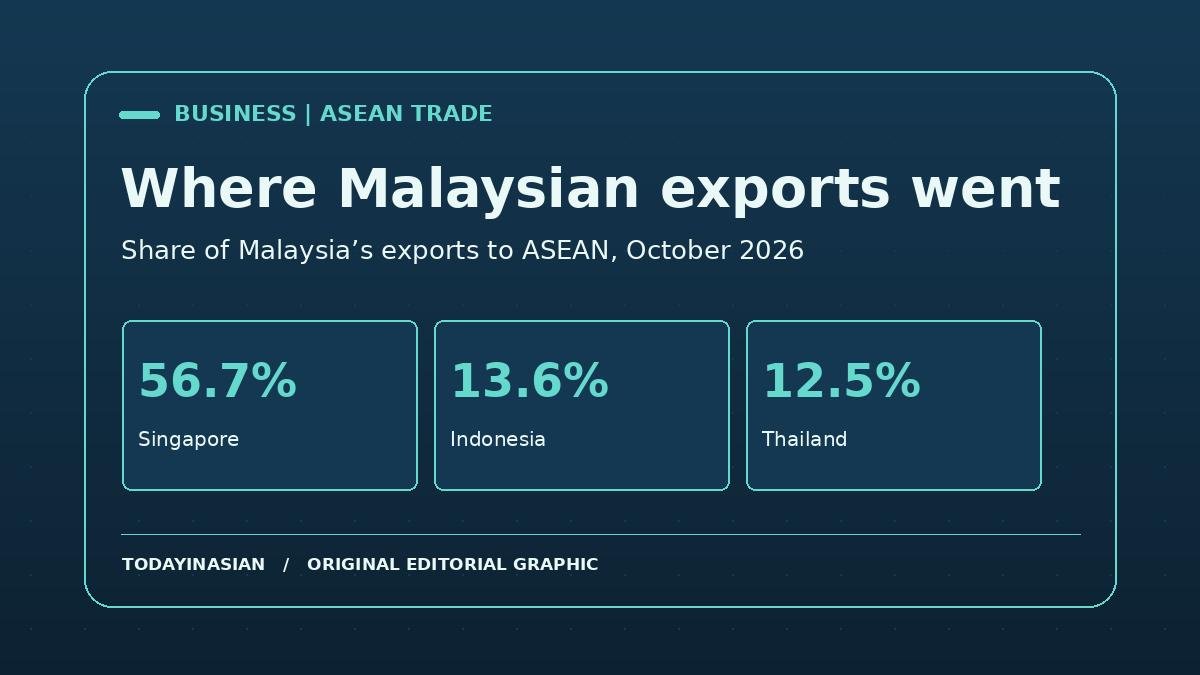
BUSINESS,- Singapore received 56.7 per cent of Malaysia’s goods exports to ASEAN in October, according to the latest detailed Malaysian external trade report. Indonesia and Thailand were next at 13.6 and 12.5 per cent respectively. The data show how important the city-state is as a market and trading hub for Malaysian suppliers, but do not tell us where every shipment ultimately ends up.
The Department of Statistics Malaysia’s detailed tables report the shares of exports to ASEAN only. They should not be confused with each destination’s share of all Malaysian exports. Separately, Malaysia’s preliminary trade report says the country’s combined imports and exports with ASEAN reached RM114.26 billion, 26.2 per cent of its total trade in October. The two figures use different denominators and count different flows.
Why the Singapore route does not tell the whole story
Many goods shipped across a border form part of a supply chain that spans several economies. A component can enter Singapore for assembly, consolidation or onward shipment. Destination data remain useful for understanding where a Malaysian business sends goods, but should not automatically be read as a measure of Singaporean consumers’ purchases. Analysts interested in onward flows can look at the Malaysian report’s separate direct-trade and Singapore-handled categories rather than assume that one share answers both questions.
The preliminary release highlights electrical and electronic products as a driver of higher exports to Singapore, Vietnam and Thailand. That provides one clue to the region’s demand and production links. It does not show that every electronics supplier received more orders, or that rising values translated into faster volume growth. Product-level tables and company reporting can help separate changes in prices and shipment mix from changes in the quantity of goods shipped.
What suppliers can take from the new breakdown
The concentration makes route reliability more important for manufacturers dependent on shipments through one hub. That is a reason to know where paperwork, freight or inventory could hold up delivery, not a reason to infer that a trade disruption is imminent. Diversifying customers and diversifying the routes used to reach them are different choices, and a supplier can have one without the other.
For analysts, another useful check will be whether the same destinations account for the largest share in later months, and whether the increase spreads beyond electronics. A high share in a single month explains regional exposure. Persistence across months would say more about how firmly the trade pattern is established.
Original editorial graphic by TodayinAsian. Source: Department of Statistics Malaysia, October 2026 external trade tables. Denominator is exports to ASEAN only.