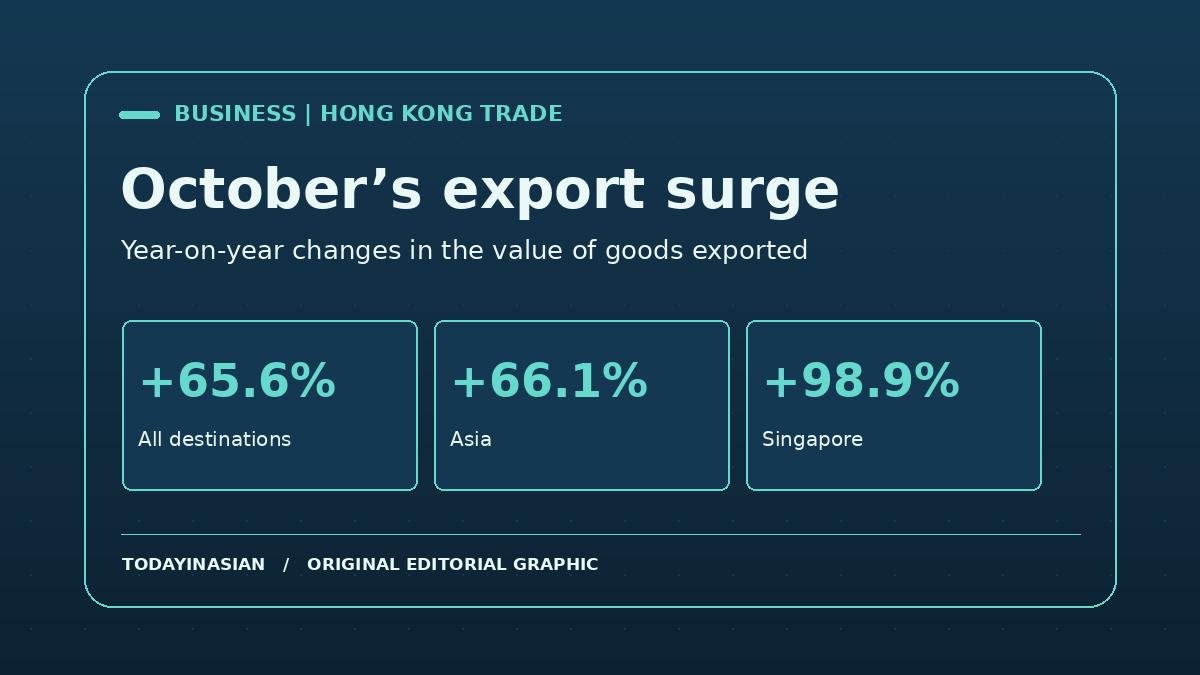
BUSINESS,- Hong Kong’s goods exports rose 65.6 per cent in value in October compared with a year earlier, with shipments recorded as going to Singapore up 98.9 per cent. Electronics demand is part of the explanation, but the Singapore figure also reflects the role of trading hubs in supply chains. The rise cannot be read as a near doubling of Singapore consumers’ purchases from Hong Kong.
The Hong Kong Census and Statistics Department reported that exports to Asia as a whole increased 66.1 per cent. Growth varied sharply by destination, including 117.3 per cent for Thailand and 47.8 per cent for Vietnam. These percentages compare the value of shipments with October 2025. They do not tell us how much any destination contributed to the overall increase unless we also know its weight in the previous period.
Why an export hub sends a different signal from a retail market
Shipments registered as arriving in one economy can be incorporated into other products or consolidated with goods going elsewhere. Hong Kong and Singapore both play roles in warehousing, distribution and regional sourcing, so a large change on the route may reflect production patterns in several markets. Final demand is a separate question that requires evidence from order books, end markets or downstream sales.
The South China Morning Post’s reporting linked the jump to demand for electronics associated with artificial intelligence. That description is more useful when paired with the underlying product tables. A larger share of higher-value items can raise the total value without the same increase in container numbers or units shipped. Firms assessing demand for freight space should look at capacity and volumes as well as prices.
What to watch beyond October
For Singapore-based distributors, the practical questions are whether purchase orders will repeat and how exposed they are to individual products or customers. A surge concentrated in a few high-value components has different implications from a broader recovery across consumer and industrial goods. Inventory balances and delivery times can help firms distinguish a one-off shipment cycle from a change they should plan around.
Where future tariff policy is uncertain, traders also need to distinguish the point from which a good is shipped from its origin for customs purposes. The latest data describe trade flows, not tariff eligibility or the rules for a given shipment. October’s figures give a clear snapshot of a busy route; their value as a longer-term signal depends on whether the increase persists and spreads across products.
Original editorial graphic by TodayinAsian. Source: Hong Kong Census and Statistics Department, October 2026 external merchandise trade release.