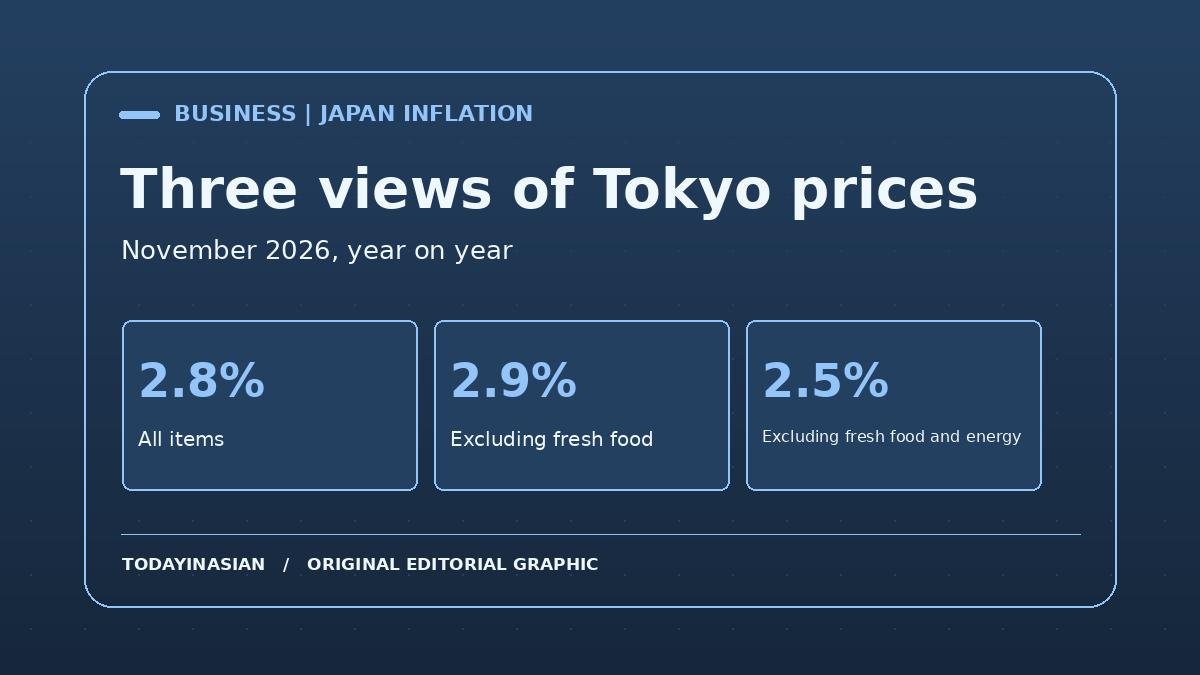
BUSINESS,- Consumer prices in Tokyo’s 23 wards rose 2.8 per cent from a year earlier in November, while the widely watched measure excluding fresh food rose 2.9 per cent. The figures point to firmer inflation in the capital, but the gap between Tokyo’s price measures helps show why one number is not enough to judge what businesses and households are facing.
The Statistics Bureau of Japan’s preliminary Tokyo release puts the rate after excluding both fresh food and energy at 2.5 per cent. Japan’s widely quoted core measure excludes fresh food only, so utility prices can still move it. Readers comparing inflation across countries should check what each index excludes before treating two rates both called core as equivalent.
What the energy bills do and do not explain
The difference between the two exclusion measures points to the importance of energy in the latest release. It is not a full attribution exercise. The indices are constructed with different baskets and weights, so their headline rates are not a substitute for looking up individual components and their contributions. Other prices matter as well: the index excluding both volatile categories still registered a rise.
Tokyo’s preliminary index is published ahead of the nationwide reading and often receives close attention for that reason. It measures the capital’s wards rather than all of Japan. The amount households spend on housing, utilities and services can differ outside Tokyo, so the national figure need not match it. Treating the early reading as a signal rather than a finished national estimate makes comparisons cleaner.
Why a stronger reading does not settle the next policy decision
The Japan Times described the latest figures as strengthening the case for a possible Bank of Japan rate increase in December. An inflation release is evidence for that discussion, not a decision. For regional traders and businesses, developments in wages, non-energy prices and official communications can help distinguish a short-lived move driven by utility bills from broader pressure on firms’ costs and households’ purchasing power.
A Singapore business paying a Japanese supplier faces another distinction: a national price index measures prices across a consumption basket, whereas the invoice is tied to its own product and currency. Cost exposures are better traced through contract terms, pricing notices and the applicable exchange rate than through the Tokyo number alone. The next nationwide figures will help show how much of the pattern seen in the capital extends elsewhere.
Original editorial graphic by TodayinAsian. Source: Statistics Bureau of Japan, preliminary Tokyo ku-area CPI, released 27 November 2026.