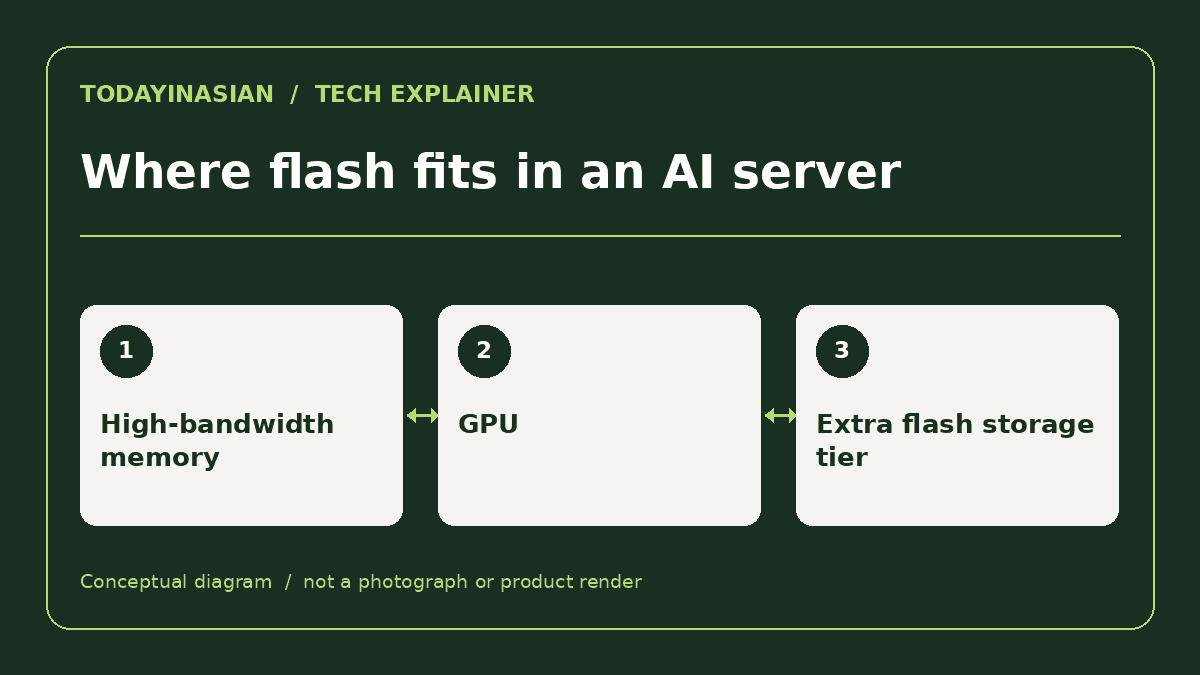
TECH,- Japanese memory maker Kioxia announced its GP2 enterprise solid-state drive on 26 November, pitching it as a supplementary tier for AI systems that need to reach more data than fits in a graphics processor’s local memory. The company says the drive can exceed 18 million random read operations per second for 512-byte blocks and reach up to 28 GB/s for sequential reads. These are company figures under different tests, not a guarantee that a model will run faster.
The announcement is about where data sits and how a processor reaches it. It is not an announcement that SSDs now offer the same latency or bandwidth as high-bandwidth memory, or HBM. Kioxia expects to make evaluation samples available to select customers in the second half of 2027. It did not announce general availability on 26 November.
Why small reads matter
Some workloads read scattered pieces of information rather than one long continuous file. Kioxia points to large graph neural networks as one example. A benchmark measured in operations per second says how many individual read requests a device can serve in the test. Sequential throughput measures how quickly it can move a longer stream. Those numbers answer different questions, and a good result in one does not automatically tell engineering teams how fast a single request will finish.
A flash tier potentially makes more data accessible without placing every byte in premium memory. It does not make flash behave like HBM. Frequently used data still benefits from staying in the fastest memory available, while another tier may make sense for larger, less frequently accessed material. Workloads with different access patterns may see very different results from the same drive.
The benchmark that would matter
StorageReview’s coverage points to the gap between earlier roadmap targets and the specifications announced for the GP2. That is a reason to compare the product being evaluated, its actual availability and the end-to-end results, rather than accept a slide from an early presentation as a purchase specification.
For teams planning regional AI infrastructure, the useful comparison is a representative application running with and without the flash tier. It should measure how often the GPU waits for data, delays on the slowest requests, energy use and cost at the same output quality. If an application already fits comfortably in fast memory or mostly reads long sequential files, the headline random-read figure may tell it little. The first customer evaluations should help separate those cases.
Hardware selection is only one part of the result. Software has to decide which data belongs in each tier and avoid shuffling it unnecessarily. A storage design that looks efficient in a laboratory can lose its advantage if a production workload continually moves the same data back and forth. How a vendor supports that integration is worth checking alongside the drive specifications.