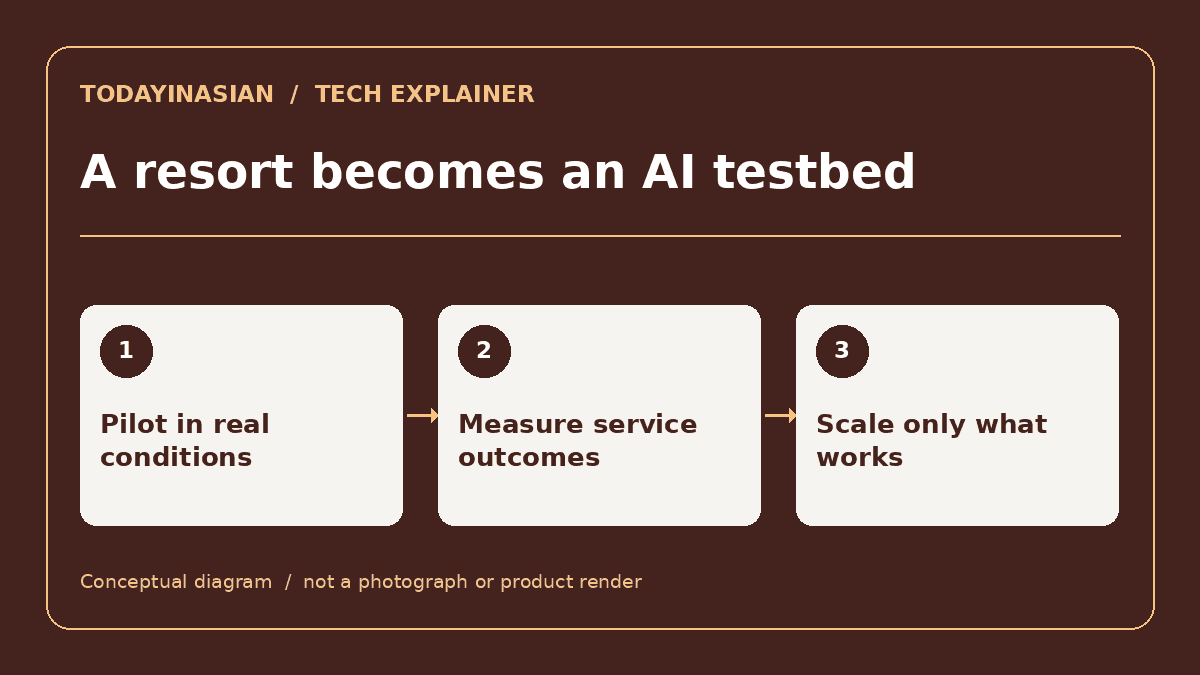
TECH,- Resorts World Sentosa launched a two-year AI testing programme on 25 November that will use its hotels, attractions and other operations to see where robots and AI software can help. The resort’s announcement identifies the programme as SYMBIOSIS and names the Infocomm Media Development Authority and Singapore Tourism Board as supporters. The test is not just whether a device works in isolation, but whether it helps people deliver services in an open, busy venue.
CNA reported that trials include a refrigerated delivery vehicle, a robot that gives directions and AI simulations that let staff practise difficult interactions. These cover different kinds of work. A cold delivery has a route, timing and temperature requirements. A training simulation is useful only if it improves how people respond to a guest in a genuine encounter.
Different pilots need different measures
A practical test for the vehicle would compare late deliveries, temperature excursions and the time spent handling exceptions before and during the trial. A route that works with light foot traffic might need a different evaluation at peak hours. The relevant comparison is not whether a robot can complete one successful run, but whether service stays dependable on an ordinary busy day.
A wayfinding robot raises another question: can a visitor who needs an accessible route or speaks a language the robot does not support still get help quickly? For staff training, a simulation can offer a safe way to rehearse, but the outcome to measure is how staff handle similar situations later, not simply how many sessions they completed.
How a resort trial can travel
At the launch, Senior Minister of State Tan Kiat How highlighted safety, security and interoperability, and cautioned that some applications might not be ready or financially viable. That is particularly relevant for tourism operators elsewhere in Southeast Asia. Their buildings, staffing models and budgets will not be the same as those at a large Singapore resort.
The lessons worth sharing would include procedures for when a robot stops, the staff time required to supervise it and which tools integrate easily with existing building systems. They would also describe where human assistance is still necessary. Other venues could then judge the trade-offs without assuming they need to buy the same machines. That is what would make a resort trial useful even for operators who never install a robot.
It is also worth distinguishing small-scale productivity from system-wide gains. A vehicle that frees up one kitchen run might require someone else to clear its route or step in at a loading point. Measuring the time all teams spend, rather than just the tasks the robot completes, gives operators a better answer about whether the pilot made an operation easier. A test can be useful even if its best decision is not to scale a particular device.