INTERNATIONAL,- Asian and European education ministers have welcomed a Philippine proposal to connect island and coastal universities across both regions. The discussion in Panglao, Bohol, ended on 26 November and focused in part on marine research and adaptation to climate risks. Ministers’ support creates an opening for universities to work together, but does not on its own provide a common budget or launch a research project.
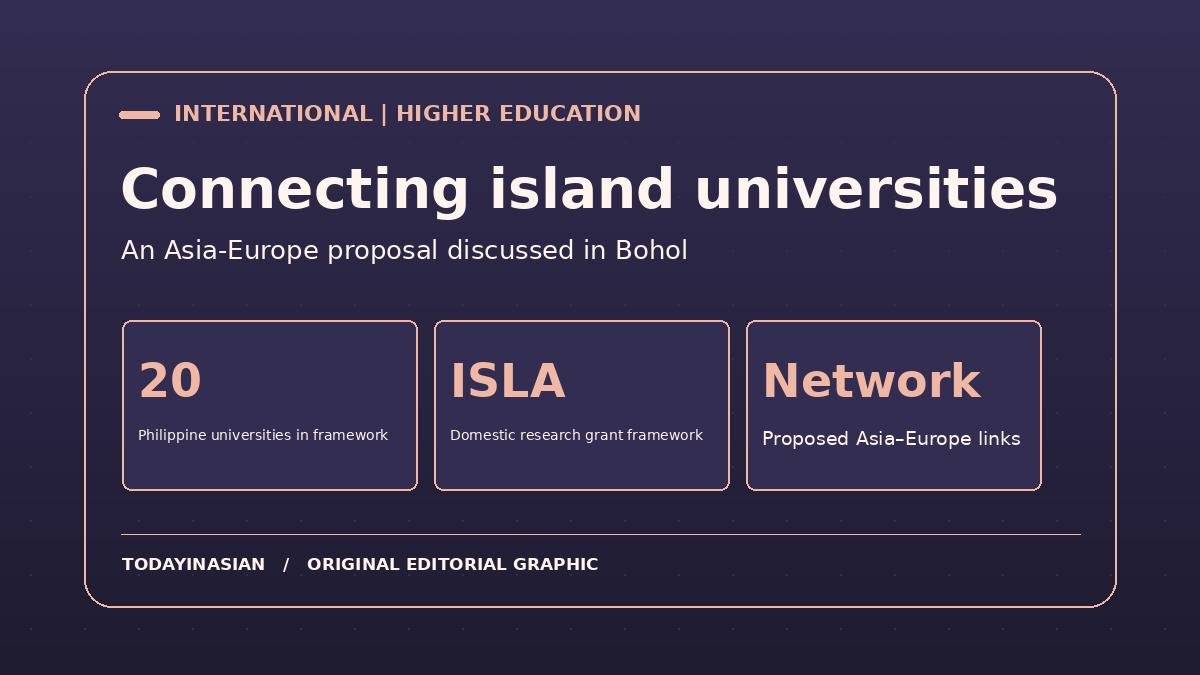
The Philippine Information Agency’s report from the meeting described a domestic policy framework covering 20 Philippine island universities. The Commission on Higher Education presented its Island Solutions for Local Advancements grant framework and proposed links to European coastal institutions. The meeting’s conclusions welcomed the framework and invitation. They should be read as support for developing a network, not confirmation that every prospective partner has signed up.
Why a network of small institutions can add something
Universities living with coastal erosion, changing fisheries or severe weather may have observations that a distant research institution would struggle to collect consistently. Comparing similar observations across islands can help researchers distinguish a local trend from a wider one. That depends on agreeing how to sample and report data, rather than designing a separate approach for every visiting project.
A sensible first step would be a small study with compatible measurements at a handful of sites, a plan for storing the data and a clear description of what local organisations can use. Potential applications include monitoring coastal habitats or comparing how communities prepare for flooding. Those are examples of what the partnership could support; the ministers did not announce projects in those areas.
Mobility is related, but not automatic
Delegates also discussed mobility and recognition of qualifications. Separately, UNESCO reported that the Philippines had become the first Southeast Asian state party to its Asia-Pacific higher education recognition convention. That development is not the same initiative as the coastal research network, and recognition arrangements do not automatically create scholarships, funding or transfer routes. Still, compatible academic rules can make some cross-border research partnerships easier to operate.
For Southeast Asian institutions outside the initial group, useful signs of progress would be a list of participating universities, open calls for joint work and clarity about whether each partner can retain and reuse the data it helps collect. The proposed collaboration will matter most where it leaves local researchers with stronger capacity after a project ends, rather than only generating another regional meeting.
Bohol supplied a forum for the idea. Its consequences will be clearer once universities, communities and government agencies can see what joint work is funded, who leads it and which results are shared.
Original editorial graphic by TodayinAsian. Source: Philippine Information Agency, reporting on the 25–26 November education ministers’ meeting.