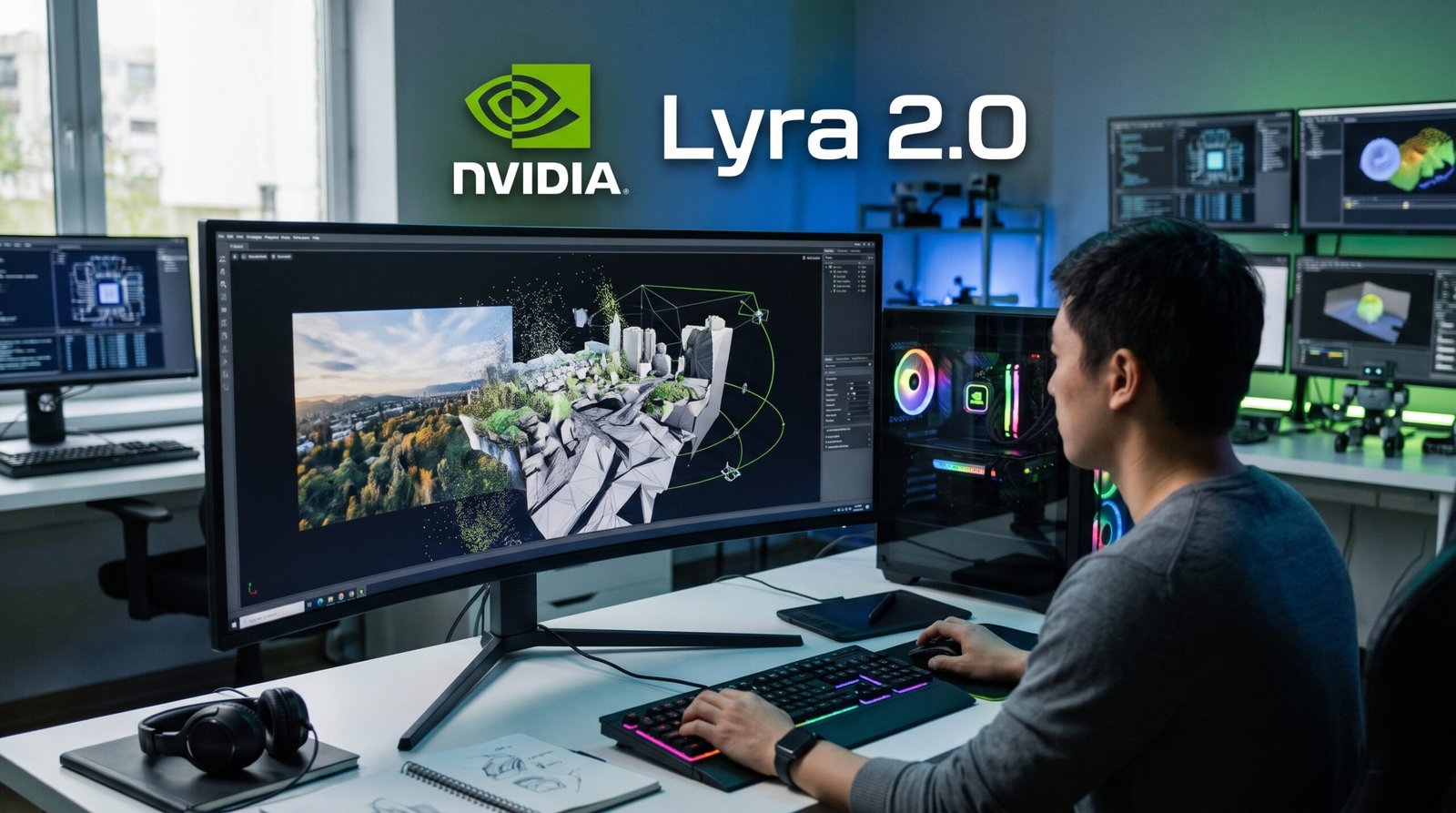
TECH – Imagine taking a photograph of a quiet street, then stepping beyond its original frame to explore nearby buildings, hidden corners and surrounding scenery. NVIDIA is bringing this concept closer to reality with Lyra 2.0, an artificial intelligence framework designed to transform a single image into an explorable three-dimensional environment. According to Wccftech, the technology combines AI video generation with 3D reconstruction, potentially opening new possibilities for gaming, virtual reality and robotics simulation.
Developed by NVIDIA’s Spatial Intelligence Lab, Lyra 2.0 addresses two major problems that often affect AI-generated environments: spatial forgetting and temporal drifting. Spatial forgetting occurs when an AI model loses information about previously generated locations, causing inconsistencies when users revisit them. Temporal drifting happens when small visual or geometric errors accumulate during extended generation, gradually distorting the environment.
To overcome these limitations, NVIDIA researchers introduced a spatial-memory system that uses 3D geometric information to retrieve relevant frames from previous exploration. The framework also employs self-augmented training, exposing the model to its own imperfect outputs so it can learn to correct accumulated errors instead of reproducing them.
Read More: Micron Reveals Ambitious DRAM and NAND Roadmap for AI Era
Unlike conventional image-to-video systems that generate predetermined sequences, Lyra 2.0 allows users to control camera movement and explore an environment through different viewpoints. Its generated video sequences can subsequently be reconstructed into 3D Gaussian representations and polygonal meshes, making the resulting environments suitable for real-time rendering.
The performance improvements are particularly interesting. NVIDIA developed a distilled version of the model that reduces the generation process from 35 denoising steps to just four. According to the research, producing an 80-frame segment takes approximately 15 seconds on a single NVIDIA GB200 GPU, compared with 194 seconds using the full model.
The reconstructed environments can also be exported into NVIDIA Isaac Sim, creating opportunities for robotics training and simulation. However, Lyra 2.0 still has limitations, including difficulties generating dynamic environments and occasional visual inconsistencies. Its generation process also remains computationally demanding rather than fully real-time.
NVIDIA has published the research paper, implementation and model weights, allowing developers and researchers to explore the framework. The project has been accepted to SIGGRAPH Asia 2026, placing it among the emerging technologies shaping the future of generative 3D environments.