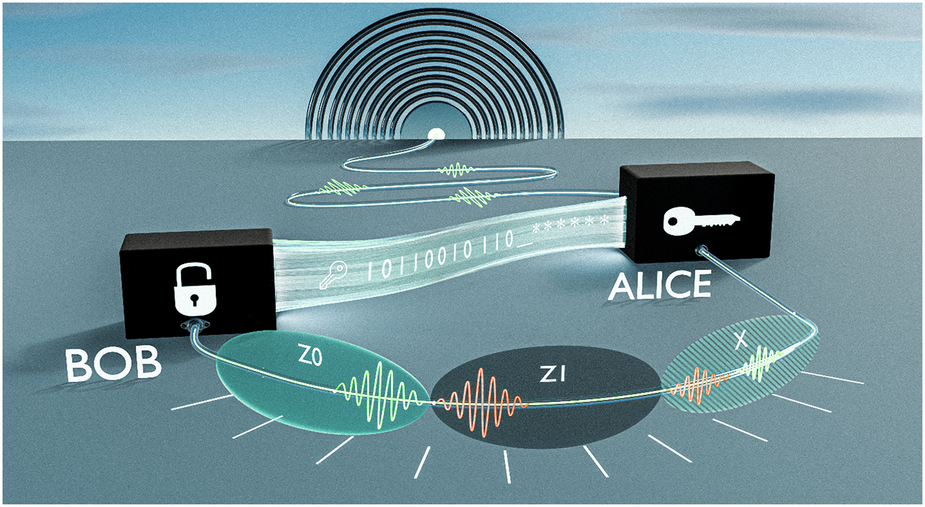
TECH – In the delicate world of quantum physics, where information travels as whispers of light, scientists have achieved a breakthrough that feels almost like bending the rules of secrecy itself. According to reporting by SciTechDaily, researchers have successfully transmitted ultra-secure encryption keys over a distance of 120 kilometers using quantum dots, tiny semiconductor particles that behave like artificial atoms, unlocking new possibilities for truly unhackable communication.
At the heart of this achievement lies a concept known as quantum key distribution (QKD), a method of encryption that does not rely on mathematical complexity, but on the fundamental laws of physics. Unlike traditional systems—which can, in theory, be broken by powerful computers—QKD ensures that any attempt to intercept the communication alters the quantum state itself, immediately revealing the presence of an intruder.
What makes this experiment particularly striking is the use of quantum dots as a source of single photons. These engineered nanostructures can emit light particles on demand with remarkable precision, overcoming a long-standing challenge in quantum communication: the need for stable, high-quality photon sources. Previous systems often struggled with inconsistencies, but the new approach delivers photons that are both pure and reliable, allowing secure signals to travel much farther than before.
Read More: Rice Engineers Create Bacteria Sensor That Generates Electricity
To carry information across such a long distance, the researchers used a technique called time-bin encoding, where data is embedded in the precise timing of photon arrivals rather than their orientation. This method proves far more resilient to environmental disturbances, such as temperature fluctuations or fiber imperfections, which have historically limited the reach of quantum networks.
The result is remarkable: secure quantum keys successfully transmitted across 120 kilometers of optical fiber, a distance that brings the technology closer to real-world deployment in city-scale or even global communication systems. Throughout the experiment, the system maintained a low error rate and a stable key generation process, demonstrating not just theoretical promise, but practical viability.
Although no direct dialogue appears in the original report, the scientific message resonates clearly—this is not merely an incremental improvement, but a shift toward scalable quantum infrastructure.
In other words, this breakthrough signals the quiet emergence of a future where data is protected not by code alone, but by the unbreakable logic of nature itself, where even the act of spying becomes impossible without leaving a trace.