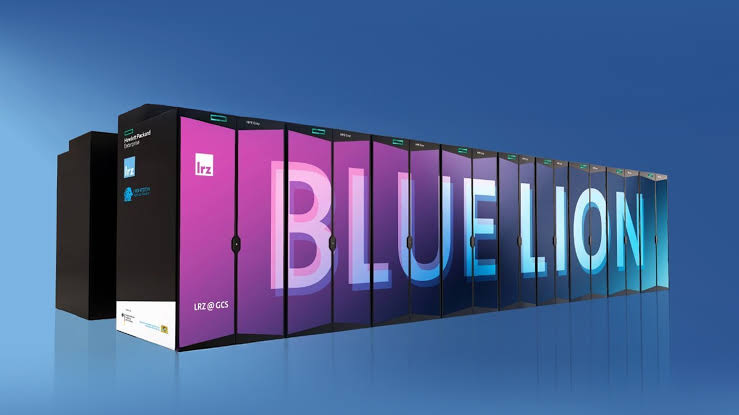
TECH – Germany’s Leibniz Supercomputing Centre (LRZ) will soon deploy Blue Lion, a next-generation supercomputer built by Hewlett Packard Enterprise (HPE) using HPE Cray architecture and NVIDIA’s cutting-edge Vera Rubin platform. Unveiled on June 14, 2025, the system delivers approximately 30 times the performance of its predecessor, SuperMUC‑NG, and is tailored to tackle large-scale scientific workloads by integrating simulation, data analysis, and artificial intelligence in a unified environment.
The core of Blue Lion combines Rubin GPUs—successors to NVIDIA’s Blackwell series—with NVIDIA’s first custom Vera CPU, designed to operate in tandem. This hardware synergy delivers high bandwidth and minimal latency for demanding compute tasks . To handle the intensive workloads, the system features robust storage and high-speed interconnects supported by HPE’s advanced hardware.
A distinguishing feature of Blue Lion is its 100% direct liquid cooling system. Warm water circulates through the racks, extracting heat without the noise or energy cost of fans. This eco-smart design enables the reuse of thermal energy to heat nearby buildings, boosting energy efficiency and sustainability.
Read More: NVIDIA’s AI‑Driven Humanoids Manage Industrial Tasks
Blue Lion is destined to support research across a variety of fields including climate modelling, fluid dynamics, physics, and machine learning. It will enable scientists to seamlessly combine traditional simulations with real-time AI-driven analyses . The supercomputer is scheduled to be ready for researchers in early 2027, also facilitating collaborative European science initiatives.
In parallel, the Lawrence Berkeley National Lab in the U.S. is developing Doudna, another Vera Rubin‑based supercomputer. Doudna will serve over 11,000 researchers, linking data from a range of instruments like telescopes, genome sequencers, and fusion reactors in real-time workflows. It is expected to deliver approximately tenfold the performance of its predecessor, with improved energy efficiency.
Officials emphasize that Blue Lion and Doudna embody a paradigm shift in high-performance computing. NVIDIA describes the Vera Rubin platform as “collapsing simulation, data and AI into a single, high-bandwidth, low-latency engine for science” . This architectural convergence signals that AI is no longer an add-on, but an integral element of scientific computation.
Both supercomputers are emblematic of a changing landscape wherein exascale systems not only perform traditional computations but also deliver real-time intelligence through AI‑enabled processes. As global scientific challenges grow more complex, infrastructures like Blue Lion are vital for enabling next-generation research capabilities.
Source: medcom.id