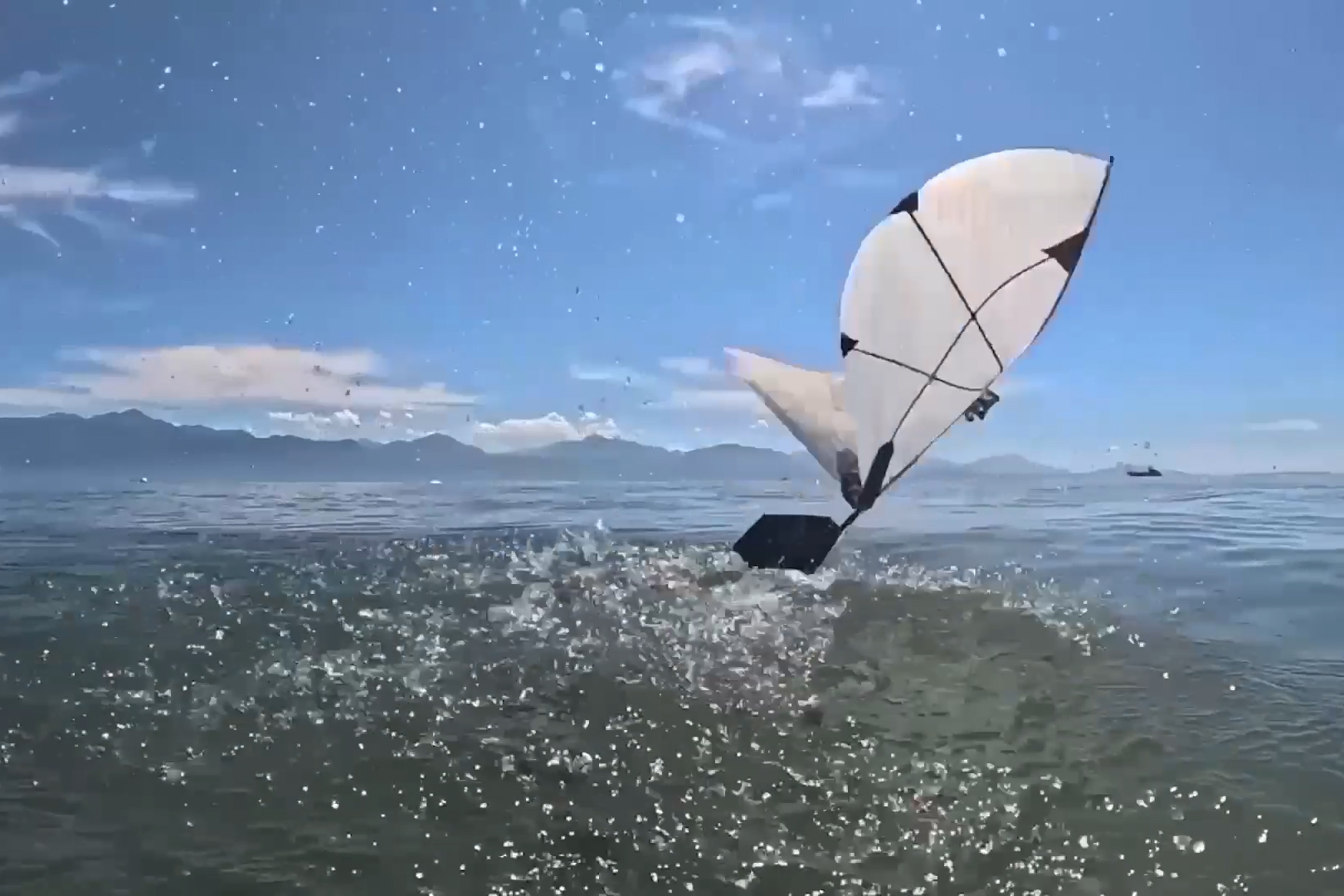
TECH – Engineers at the Massachusetts Institute of Technology (MIT) have developed an innovative flapping robot capable of both flying through the air and swimming underwater, taking inspiration from seabirds that effortlessly transition between the two environments. According to MIT News, the lightweight robot mimics the movements of diving birds such as puffins and auks, using the same pair of flapping wings to generate lift in the air and propulsion beneath the water. The achievement represents an important step toward creating highly versatile robots that can operate across multiple environments without requiring separate propulsion systems.
Unlike conventional aerial drones or underwater vehicles, which are typically designed for only one mode of transportation, the MIT robot seamlessly switches between flight and swimming by adjusting how its wings move. The researchers engineered the wings to flap with different patterns depending on whether the robot is in the air or underwater, allowing it to maintain efficient movement despite the dramatic differences in air and water density. This biomimetic approach reduces mechanical complexity while improving adaptability in changing environments.
According to MIT News, the research team designed the robot to be lightweight yet durable enough to withstand repeated transitions between flight and underwater operation. Laboratory tests demonstrated that the robot could successfully dive beneath the water’s surface, propel itself using its flapping wings, and then return to the air after completing underwater maneuvers. The project builds upon years of research into animal-inspired robotics, where engineers study the movement of birds, fish, and insects to create machines with greater agility and efficiency.
Read More: Humanoid Robots Perform First Live Teleoperated Surgery
Discussing the inspiration behind the design, the researchers explained, “Birds have already solved many of the engineering challenges that we face.” They noted that diving seabirds provided an ideal model because they naturally excel in both aerial flight and underwater navigation. By understanding these biological adaptations, the team hopes to develop robots capable of performing complex missions that would be difficult for existing unmanned vehicles.
Potential applications for the technology include environmental monitoring, marine wildlife observation, search-and-rescue missions, offshore infrastructure inspection, and scientific exploration in coastal regions. A robot that can independently fly to a remote location before diving underwater could significantly reduce operational costs while increasing flexibility for researchers and emergency responders.
Looking ahead, as highlighted by MIT News, the flapping robot demonstrates how nature continues to inspire next-generation engineering solutions. Although additional development is needed before real-world deployment, the successful prototype shows that combining aerial and underwater mobility into a single autonomous machine may soon become a practical reality, opening new possibilities for robotics in both scientific research and environmental conservation.