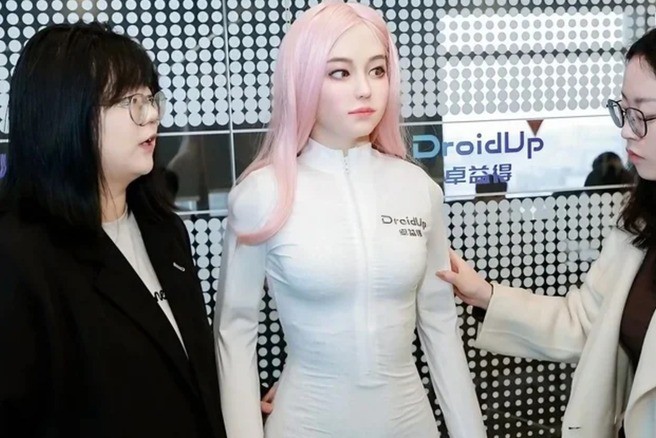
TECH – Researchers in Shanghai have introduced a groundbreaking humanoid robot called Moya, described as the world’s first fully biomimetic AI system designed to replicate the way the human body moves. Unlike conventional robots that rely on rigid motors and mechanical joints, Moya uses soft, muscle-like structures that enable fluid, lifelike motion—marking a significant shift in robotics design.
At the core of Moya’s innovation is its use of pneumatic artificial muscles, which are powered by air pressure rather than electric motors. These muscles contract and expand in a way that closely resembles human muscle behavior, allowing the robot to move with greater flexibility and continuity. Instead of producing stiff, segmented motions, Moya’s limbs operate in smooth, coordinated sequences that resemble natural human movement.
Read More: BYD Ti7 EV Debuts With 755 km Range and 5-Minute Charge
This design extends beyond individual limbs. The robot’s spine is engineered to bend and rotate, enabling full-body coordination. When Moya reaches for an object, its movement is not limited to a single joint—instead, its shoulders, torso, and balance adjust simultaneously. The result is a more holistic form of motion, where the entire body participates in each action rather than reacting in isolated steps.
However, replicating biological movement introduces a major technical challenge. Unlike rigid systems, pneumatic muscles can behave unpredictably depending on pressure, load, and environmental conditions. To address this, researchers developed an advanced control framework often described as “embodied intelligence.” Rather than correcting errors after they occur, Moya’s AI anticipates how its body will respond before executing a movement. This predictive approach allows the robot to maintain balance, adjust force, and coordinate motion in real time.
The outcome is a level of movement that appears deliberate and continuous. Demonstrations show Moya transitioning between actions without abrupt stops or mechanical corrections. Its motions flow naturally, avoiding the jerky patterns commonly associated with humanoid robots. This creates a more intuitive and less mechanical presence, especially in environments where human interaction is involved.
Read More: Germany Deploys Robot Arms for Nuclear Waste Mine Cleanup
Developers are focusing on applications beyond industrial automation. Moya is being designed for human-centered settings such as healthcare, education, and service environments, where natural interaction plays a critical role. Its softer movements, controlled physical responses, and human-like motion are intended to make interactions feel more comfortable and less intimidating.
The development of Moya reflects a broader shift in robotics—from machines built purely for efficiency to systems designed for adaptability and coexistence. By combining artificial intelligence with biologically inspired mechanics, researchers are moving closer to creating robots that not only perform tasks effectively, but also move and interact in ways that feel fundamentally human.