TECH – Researchers and startups connected to the Korea Advanced Institute of Science and Technology (KAIST) are rapidly moving robotics out of laboratories and into real-world environments. Their latest developments demonstrate how machines can take on demanding tasks in shipyards, busy streets, and rugged terrain.
One notable example comes from DIDEN Robotics, a startup founded in March 2024 by KAIST engineers. The company focuses on robots designed for high-risk and hard-to-reach workplaces. Its flagship model, the DIDEN 30, is a quadruped robot with magnetic feet and an animal-inspired leg design. During tests at Samsung Heavy Industries’ shipyards, the robot successfully crossed uneven steel reinforcements, proving its stability on complex industrial surfaces.
DIDEN is also developing the DIDEN Walker, a bipedal robot built for narrow and confined shipyard spaces. By 2026, the company plans to equip these robots with the ability to perform practical tasks such as welding, painting, and inspection. All development is supported by a simulation platform called DIDEN World, where the robots are trained virtually before physical trials, reducing both cost and risk.
Read More: Apple’s A19 Becomes World’s Fastest Single-Core CPU
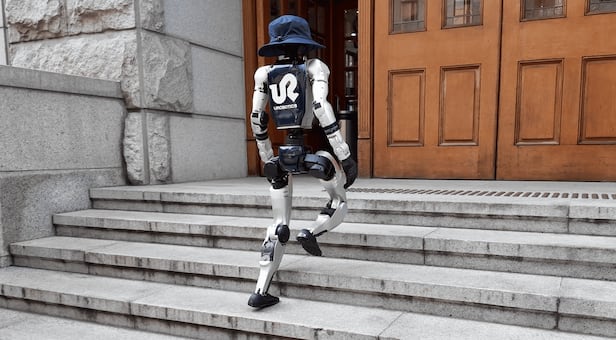
On the humanoid front, another KAIST spin-out, URobotics, is testing new ways for bipedal robots to walk independently in unpredictable public settings. Their prototype has been demonstrated navigating crowded outdoor areas in Gangnam, Seoul. What sets it apart is a “blind walking controller” system: instead of relying on external sensors like cameras or LiDAR, the robot uses internal sensors and algorithms to “imagine” the ground. This allows it to remain stable when walking over curbs, stairs, slopes, and in changing weather or lighting conditions.
Meanwhile, KAIST’s Hubo Lab has unveiled a new lower-body platform for humanoid robots, complete with domestically developed motors, reducers, and AI-based control systems trained through reinforcement learning. The robot’s lower half can run at speeds up to 3.25 m/s (around 12 km/h) and climb obstacles up to 30 cm. Future upgrades aim to push that limit to 4 m/s and handle obstacles above 40 cm, including climbing ladders.
These innovations highlight KAIST’s vision of creating robots that are more autonomous, adaptive, and industrially useful. By reducing dependence on external sensors and focusing on locally developed components, KAIST and its startups are accelerating the transfer of academic research into practical solutions—addressing labor shortages, safety challenges, and rising operational costs.