TECH – The Beijing Academy of Artificial Intelligence (BAAI) has unveiled RoboBrain 2.0, an open-source artificial intelligence framework designed to serve as the cognitive core of humanoid and other robotic systems in China. According to the report from SCMP, the announcement took place on June 7, 2025, during BAAI’s annual conference in Beijing—a strategic moment as the nation intensifies its efforts to embed advanced AI in robotics.
BAAI director Wang Zhongyuan described RoboBrain 2.0 as “the world’s most powerful open‑source AI model designed to improve various types of robots, including humanoids,” emphasizing its role in enhancing robot cognition and autonomy. This platform builds upon BAAI’s earlier model, achieving a 17% increase in spatial intelligence and a 74% boost in task‑planning accuracy—key metrics that underpin better performance in real-world environments.
Improved spatial understanding empowers robots to more accurately gauge distances and object relationships, while enhanced task planning enables them to deconstruct complex actions into sequenced, executable steps. These advances aim to address major bottlenecks in China’s robotics landscape, notably limited AI capability and the scarcity of rich training datasets.
RoboBrain 2.0 forms part of BAAI’s broader Wujie model ecosystem, which also includes RoboOS 2.0—a robotics AI deployment platform—and Emu3, a multimodal model adept at processing and creating text, images, and videos. These tools collectively support an integrated pipeline for robotic intelligence—from model development to real-world deployment.
Read More: Amazon Trials Humanoid Robots for Package Delivery
During the conference, Wang expressed the institute’s ambition to increase industry synergy, stating: “We hope many players in the field of embodied intelligence will work together with the Zhiyuan Institute.” He noted partnerships are already in place with over 20 leading robotics firms, with further collaborators invited to join.
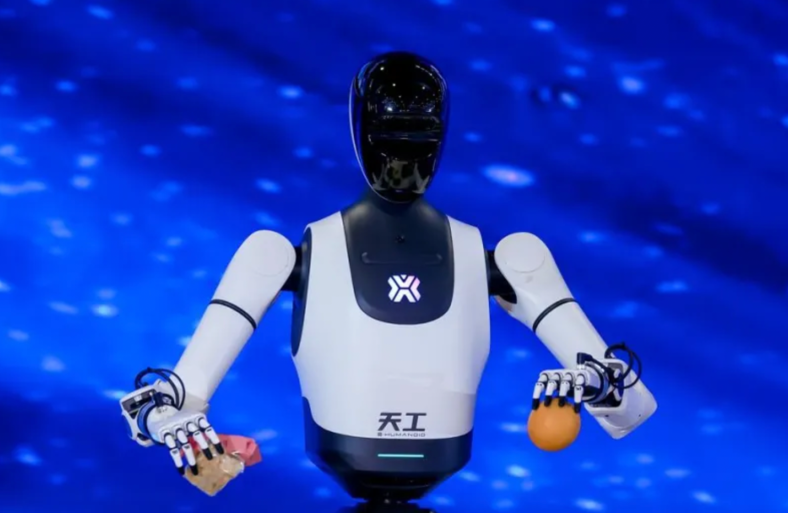
China’s push in humanoid robotics extends beyond BAAI. The Beijing Humanoid Robot Innovation Centre also launched the Hui Si Kai Wu platform earlier this year—its AI-powered Tien Kung humanoid robot famously completed a half‑marathon in Beijing in April—positioning itself as a potential “Android of humanoid robots”.
However, the path forward faces external challenges. In March, the US added BAAI to its Entity List, restricting the institute’s access to American technology. Director Wang termed this move “a mistake” and the academy is actively seeking to reverse the designation.
Despite such hurdles, BAAI continues to broaden its influence. At the event, it announced a strategic alliance with the Hong Kong Investment Corporation to enhance AI innovation through shared resources and talent. The conference welcomed over 100 international AI experts, along with representatives from Baidu, Huawei, Tencent, Unitree Robotics, Zhipu AI, and Shengshu AI.
By releasing RoboBrain 2.0 as open source, China aims to spark a global collaboration in humanoid AI development. The model’s enhanced autonomy, planning abilities, and modular integration mark a promising step toward intelligent robots capable of navigating and assisting in complex human environments