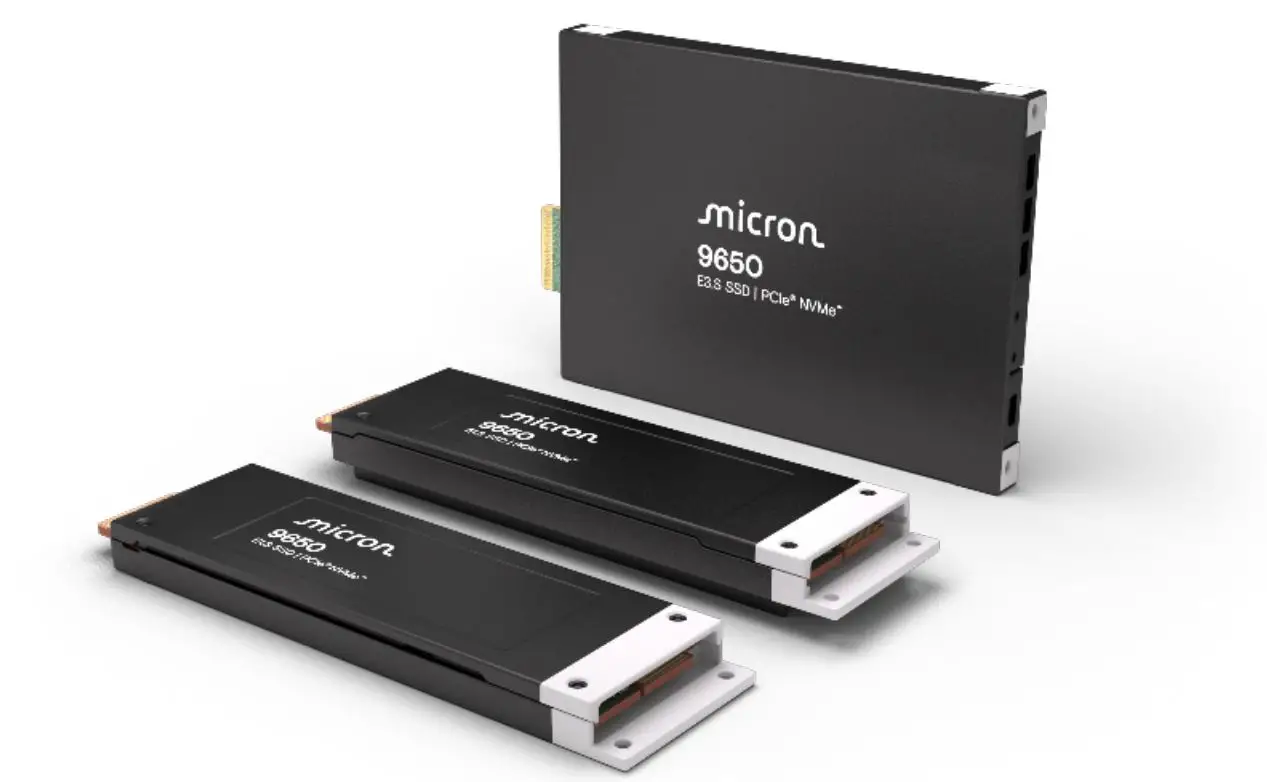
TECH – Micron has reached a major milestone in storage technology by starting mass production of its 9650 NVMe SSD, the world’s first PCIe Gen6 drive available at scale, marking a key moment in the evolution of data-center storage, according to TrendForce and multiple market reports. This new SSD ushers in the next generation of high-speed storage with performance that roughly doubles the throughput of PCIe Gen5 systems, a leap that resonates particularly strongly with the booming demand from artificial intelligence (AI) and data center workloads that strain current data pipelines and storage systems.
At its core, the Micron 9650 leverages the PCIe Gen6 x4 interface and the NVMe 2.0 protocol to push sequential read speeds up to 28,000 MB/s and sequential write speeds up to 14,000 MB/s, figures that outpace today’s fastest PCIe Gen5 SSDs by a wide margin. Random access performance is equally impressive, with upwards of 5.5 million IOPS (input/output operations per second), ensuring that massive volumes of data — such as those used in AI model training or large-scale analytics can be accessed with minimal latency. These performance gains are essential for modern data centers, where storage bottlenecks can dramatically slow down processing and inflate operating costs.
Read More: Oji Holdings Advances EUV Photoresist for 2nm Chips Development
One of the most striking aspects of this development is how Micron has balanced raw speed with energy efficiency. The drives deliver much greater throughput at roughly the same 25-watt power envelope as current high-end enterprise SSDs, offering data center operators higher performance per watt and helping larger installations keep energy costs manageable while boosting performance. Such efficiency improvements are crucial as global AI and cloud workloads expand, with data centers already consuming significant shares of total electricity.
The Micron 9650 comes in two main variants — PRO and MAX — both sharing the top-end throughput figures but differing in endurance ratings and capacity configurations. The PRO series offers capacities up to 30.72 TB, designed for broad performance demands, while the MAX series targets environments with heavier write workloads and higher long-term resilience. Both support advanced features like security capabilities, compliance protocols, and thermal configurations that include options for liquid cooling, a response to the rising thermal demands of Gen6 performance.
Read More: US–Taiwan Trade Pact Cuts Tariffs to 15%, Boosts Market Access
The transition to PCIe Gen6 represents one of the most substantial architectural shifts in recent memory for the storage ecosystem, effectively removing long-standing bandwidth ceilings that limited how fast data could move between storage and compute resources. This expanded bandwidth enables more efficient direct communication between accelerators and storage devices — a capability increasingly important in AI-driven systems where datasets are vast and real-time access is critical to performance.
Micron’s move effectively positions the 9650 as a flagship solution for next-generation infrastructure, and while PCIe Gen6 adoption in consumer PCs isn’t expected until much later — possibly around 2030 as some industry voices predict — the enterprise and high-performance computing markets are already gearing up to make the most of this technological leap. The advent of mass-produced Gen6 SSDs also pressures other manufacturers to accelerate their own development, promising an increasingly competitive and innovative future for storage technology.