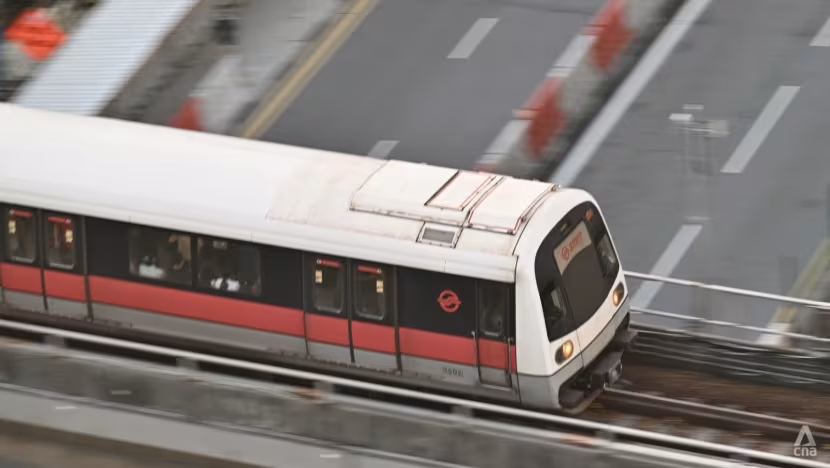
SINGAPORE – Increasing the railway reliability target could have an impact on the cost burden to be borne by the public, either through taxes or fares, said Transport Minister Chee Hong Tat. Currently, the railway reliability target used is the mean kilometres between failure (MKBF) of 1 million kilometres, which is considered to remain relevant and valid.
Minister Chee made this statement during the parliamentary session on Monday (11 November), in response to a question from Opposition Leader Pritam Singh. Singh questioned whether the Ministry of Transport (MOT) plans to raise the target, given that the 1 million MKBF figure was set about five years ago.
Chee explained that the figure is based on the standards achieved by the world’s most reliable train operators, such as those in Taipei and Guangzhou. ‘To date, this target remains relevant, valid, and our main focus,’ Mr Chee said. However, he added that any potential increase in the target should be carefully considered as there will be cost consequences in terms of taxes or user charges.
Railway Reliability Challenges Amid Service Disruptions
The discussion on railway reliability comes after a series of disruptions to the MRT and LRT systems in recent months. One major disruption occurred last September, when train services on the East-West Line were disrupted for six days due to severe damage caused by a faulty train. In addition, service disruptions also occurred on the Bukit Panjang LRT line due to a train wheel failure, with services only restored a day later.
Chee, however, noted improvements in overall system reliability. MRT’s MKBF increased from about 1.8 million kilometres at the end of September to almost 2 million kilometres at the end of October. ‘We will continue to focus on keeping the MKBF above the 1 million target, as safety and reliability are very important to users,’ he explained.
SMRT has also set up a working group to evaluate their systems and processes, including maintenance practices. The group involves the Land Transport Authority (LTA), the National Transport Workers Union, as well as international metro operators from Guangzhou and Taipei for a learning exchange.
Bukit Panjang LRT Rejuvenation Progress
MP Yeo Wan Ling requested an update on the cause of the breakdown on the Bukit Panjang LRT line between Bukit Panjang and Choa Chu Kang stations. Based on LTA’s preliminary findings, the incident was caused by a wheel failure that caused the train’s tyres to deflate due to excessive friction. This resulted in damage to the tracks and a power outage.
Meanwhile, the renewal of the Bukit Panjang LRT system, which started in 2018, continues to progress. The S$344 million refurbishment project includes new signalling and electrical rail systems, as well as the renewal of the train fleet. Originally scheduled for completion in 2024, the project has been delayed to 2026 due to the pandemic. To support this process, train services on the line will end one hour earlier every Thursday to Sunday from 14 November 2024 to 31 October 2025, except on public holidays.
Chee emphasised that the refurbishment remains on schedule for completion in 2026. ‘We realise that this is a long journey, but these improvements are necessary to address long-standing issues and provide better services for users,’ he said. He also expressed his appreciation to passengers and residents for their patience during the refurbishment process.