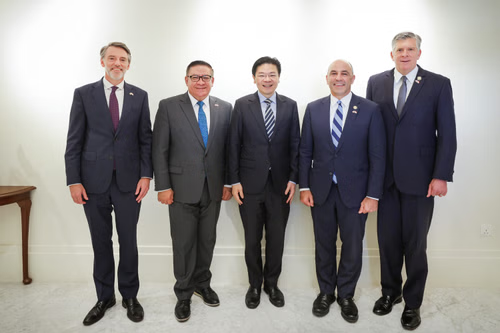
BUSINESS – Deputy Prime Minister and Minister for Trade and Industry Gan Kim Yong emphasized Singapore’s commitment to fostering robust economic relations with the United States, despite the global rise in protectionist sentiments. Speaking at the inauguration of the American Chamber of Commerce in Singapore’s (AmChamSG) new office, DPM Gan highlighted the mutual benefits derived from the longstanding partnership between the two nations.
Singapore hosts approximately 6,000 US companies, many of which utilize the city-state as a strategic base to distribute American products and services throughout the region. Conversely, over 250 Singaporean enterprises have established operations across 45 US states, positioning Singapore as the third-largest Asian investor in the US, following Japan and South Korea. Recent data indicates that income generated by US firms from investments in Singapore nearly doubled to US$51.4 billion between 2020 and 2023. This figure represents over 40% of the total income from US investments in the Asia-Pacific region, underscoring the significance of Singapore as a pivotal economic partner.
In response to escalating economic nationalism and protectionist trends, Singapore is actively collaborating with like-minded nations to reinforce the international, rules-based trading system. This includes strengthening institutions such as the World Trade Organization (WTO) and engaging in initiatives like the Comprehensive and Progressive Agreement for Trans-Pacific Partnership (CPTPP). Within the Association of Southeast Asian Nations (ASEAN), Singapore and its partners are enhancing economic integration by upgrading existing Free Trade Agreements (FTAs). These enhancements aim to further reduce tariff and non-tariff barriers, address emerging trade areas such as supply chain resilience, and establish new cooperation frameworks in fields like artificial intelligence, digitalization, and the low-carbon transition.
Read More: Indonesian Passenger Faces Charges for In-Flight Indecency
Singapore is also deepening economic ties with neighboring countries. The recent Agreement on the Johor-Singapore Special Economic Zone (JS-SEZ) with Malaysia exemplifies efforts to facilitate cross-border movement of people and goods, improve the ease of doing business, and support talent development. Such initiatives aim to create synergistic opportunities by leveraging the complementary strengths of both regions.
DPM Gan encouraged US companies to explore partnerships with Singaporean firms, particularly in areas like digitalization and sustainability. He highlighted Singapore’s Partnerships for Capability Transformation (PACT) program, which supports collaborations between multinational corporations and local enterprises. Additionally, he advocated for joint efforts in developing a pipeline of local managers with international experience through initiatives such as the Global Business Leaders Programme, aiming to cultivate regional and global leadership within companies.
Despite global uncertainties, Singapore remains committed to working closely with US businesses to unlock new opportunities, drive economic growth, and enhance the quality of life for citizens in both countries and the broader region.