Business
Bitcoin Sinks Below $70K as Crypto Market Faces Heavy Sell-Off


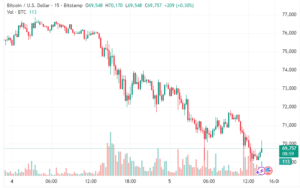
BUSINESS – Bitcoin’s price retreated sharply on 5 February 2026, slipping below the $70,000 mark and stirring jitters across global markets as the world’s largest cryptocurrency endured a deep sell-off that showed few signs of easing, according to CNBC and multiple market sources. The slide marked the first time in about 15 months that Bitcoin traded beneath this psychological support level, reflecting growing unease among traders and investors about liquidity, interest rates and broader risk sentiment.
Traders watched in real-time as Bitcoin wavered around the crucial threshold, briefly dipping as low as near $69,000 in some exchanges before modest stabilization, a level that hasn’t been seen since late 2024. Market watchers noted that over the prior 24 hours, prices had fallen in the 7–9% range, deepening a broader downturn that has erased a significant portion of the gains Bitcoin made in recent years.
Analysts pointed to several forces accelerating the decline. One key driver was concern over tighter monetary policy, particularly after influential figures in the United States’ Federal Reserve nomination process raised expectations that liquidity in financial markets could shrink, making risk assets like cryptocurrencies less attractive. That sentiment spilled over into cryptocurrency markets, triggering further selling pressure.
Read More: Norway’s Massive Wealth Fund Posts Strong $247B Return in 2025
Institutional flows also played a role. Reports show that spot Bitcoin exchange-traded funds (ETFs) saw sizeable outflows in recent sessions, reducing the infrastructure that once helped underpin price levels. Combined with leverage-driven liquidations — where overextended positions are forcibly closed — the market has experienced heightened volatility and thin trading depth.
The slump hasn’t been isolated to Bitcoin alone; other major digital assets such as Ethereum and XRP have also recorded notable declines, underscoring the widespread risk-off mood across crypto markets. Some strategists describe the current environment as a “crisis of faith” among investors, where long-standing confidence in cryptocurrency’s resilience is being tested amid macroeconomic headwinds.
Despite the bleak short-term picture, longer-term perspectives remain mixed. Some market participants see the fall below $70,000 as an opportunity for accumulation, while others believe the next support zones could emerge much lower, potentially in the $60,000s if selling momentum persists. Nevertheless, the dramatic price action reflects how sensitive digital assets are to shifts in liquidity conditions, regulatory signals and investor risk appetite — forces that are currently intensifying across global financial markets.